90 Days of KSM™: I Built the Framework, Then Put It Through Its Own Test
90 Days of KSM™: From Research Framework to Implementation Methodology
by Dr. Anthony Q. Bowen, DBA — creator of the Knowledge Structuring Model (KSM™) ·
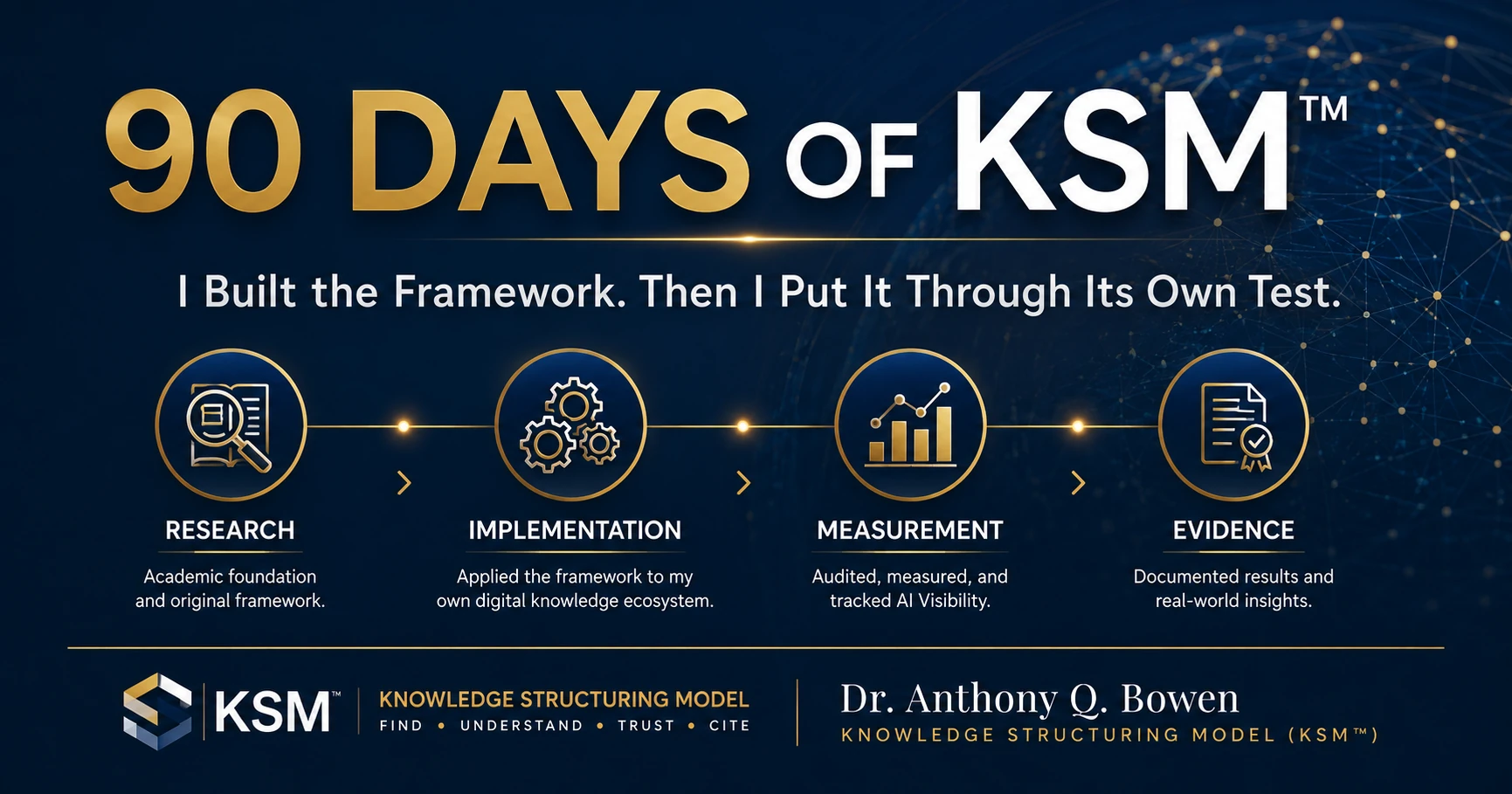
On May 5, 2026, I completed the research that introduced the Knowledge Structuring Model (KSM™).
The paper, The Knowledge Structuring Model (KSM™): A Socio-Technical Framework for AI-Mediated Visibility and Citation Authority, was subsequently posted to SSRN on May 15, 2026.
The research began with a deceptively simple question:
“What makes an organization visible, understandable, and authoritative to Artificial Intelligence?”
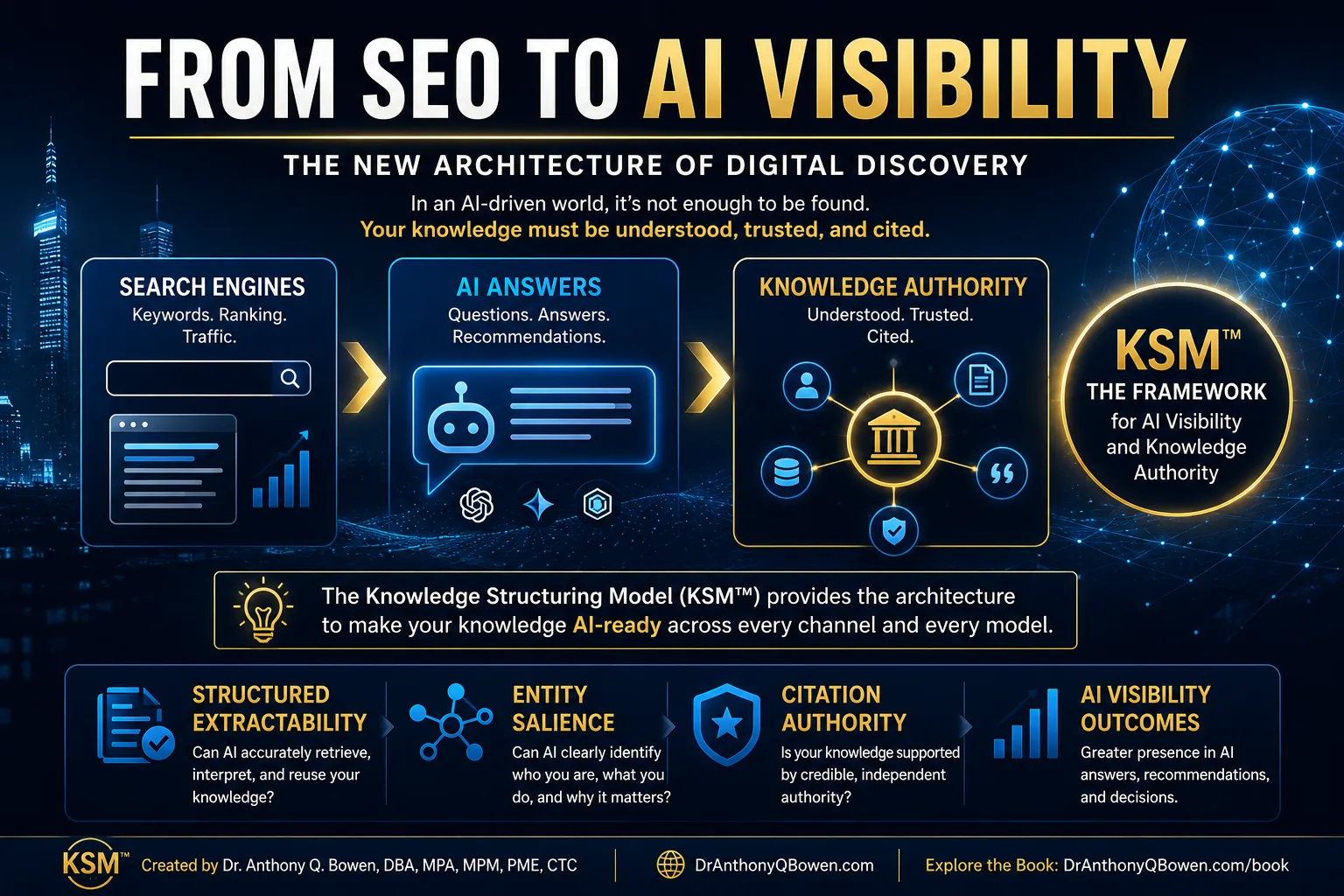
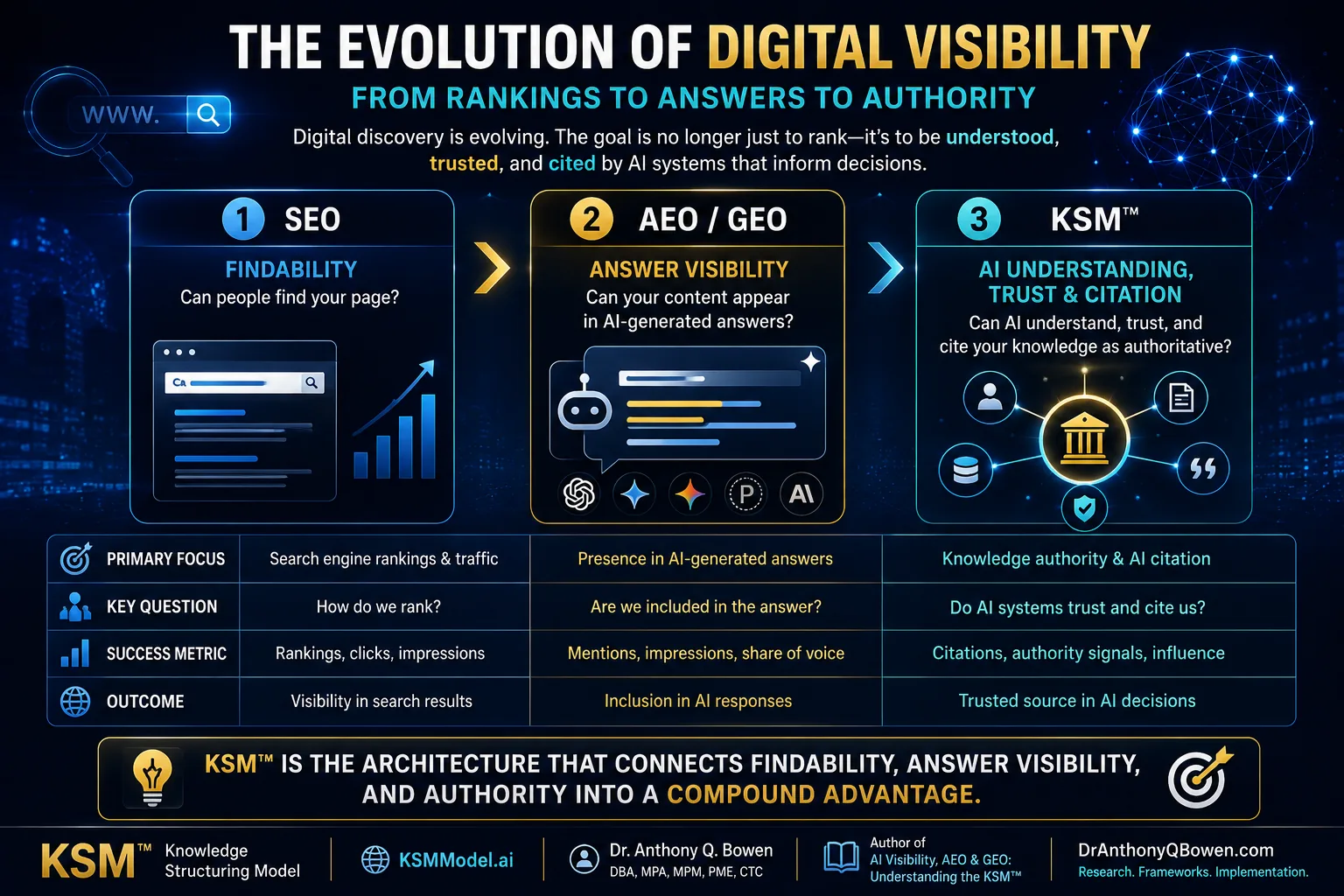
For more than two decades, organizations optimized websites primarily for search engines. Keywords mattered. Backlinks mattered. Technical SEO mattered. Rankings mattered.
They still do.
But generative AI has introduced another layer of discovery. People increasingly ask AI systems questions and receive synthesized answers rather than simply receiving a list of webpages.
That changes the visibility problem.
Organizations must now consider whether AI systems can find their knowledge, understand what it means, correctly associate it with them, determine whether it is trustworthy, and potentially cite it when constructing an answer.
KSM™ was developed to provide a framework for understanding that problem.
The Knowledge Structuring Model
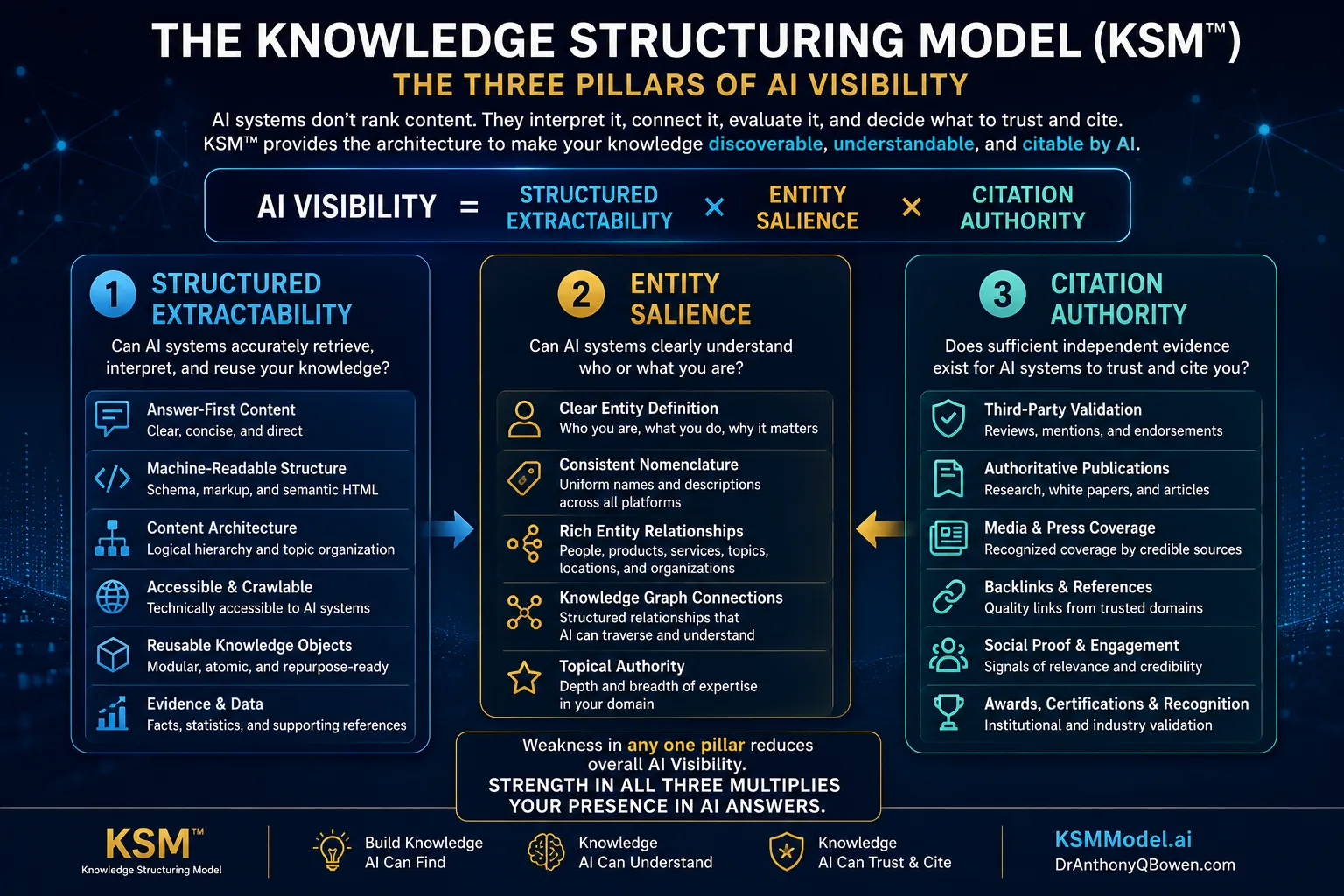
KSM™ conceptualizes AI Visibility through three interdependent organizational capabilities.
Structured Extractability
Can AI systems access, extract, interpret, and reuse the organization’s knowledge?
Entity Salience
Can AI systems accurately determine who the organization is, what it does, what expertise it possesses, and how its people, products, research, services, and ideas relate?
Citation Authority
Does sufficient credible evidence exist for AI systems to trust and potentially cite the organization’s knowledge?
AI Visibility = f(Structured Extractability × Entity Salience × Citation Authority)
- Structured Extractability (SE) — 40%
- Extractable structured content
- Entity Salience (ES) — 40%
- Entity salience and knowledge graph alignment
- Citation Authority (CA) — 20%
- Citation authority reinforcement
The 40% / 40% / 20% weights are from KSM™ Methodology v1.0 assessment scoring. They are not weights stated in the original SSRN paper.
The multiplicative relationship is important. Strong performance in one dimension cannot completely compensate for serious weakness in another.
An organization can publish excellent information, but if AI systems cannot reliably associate that information with the correct entity, its visibility may remain constrained.
Likewise, a recognizable entity without credible supporting evidence may struggle to establish citation authority.
Then I Asked a Different Question
Publishing a framework is one thing. Operationalizing it is another.
If KSM™ was going to have practical value for organizations, I believed it needed to move beyond conceptual research.
So I decided to apply the framework to something I could observe directly: my own digital knowledge ecosystem.
That included my website, research, publications, professional identity, articles, book, structured data, citations, entity relationships, and presence across the broader digital ecosystem.
“I built the framework—and then made myself the first 90-day implementation case.”
The objective was not to manufacture a predetermined result.
It was to determine where the framework exposed weaknesses, what could realistically be changed, and whether KSM™ could be translated into a repeatable implementation methodology.
What the Initial Audit Revealed
One of the most important lessons was that having substantial expertise and published knowledge does not automatically produce strong AI Visibility.
Knowledge can exist while remaining poorly structured for machine interpretation.
Expertise can exist while entity relationships remain fragmented.
Research can exist without being sufficiently connected to the author, framework, book, organization, or other related knowledge assets.
Authority can exist without being consistently reinforced across the digital ecosystem.
“Publishing knowledge is not the same as structuring knowledge.”
This became one of the central operational lessons of the 90-day experiment.
KSM™ AI Visibility Assessment
90-Day Self-Audit: The Three Pillars of AI Visibility
dranthonyqbowen.com — assessed against Structured Extractability, Entity Salience, and Citation Authority
Weighted AI Visibility Score
AI Visibility = f(Structured Extractability × Entity Salience × Citation Authority)
Weights from KSM™ Methodology v1.0 assessment scoring; the SSRN paper's equation does not assign weights.
Structured Extractability (40% weight)
93Full cross-referenced JSON-LD graph (Organization, Person, WebSite, FAQPage, DefinedTermSet, ScholarlyArticle). Google Rich Results: 8/8 valid items, 0 issues.
Entity Salience (40% weight)
69sameAs links 10 verified profiles to one @id; disambiguatingDescription neutralizes name-collision risk. Capped by no Wikidata entity yet.
Citation Authority (20% weight)
44ScholarlyArticle schema carries proper DOI/SSRN identifiers and periodical metadata; third-party citation volume still early-stage.
KSM™ · Dr. Anthony Q. Bowen, DBA · ksmmodel.aiAssessed August 19, 2026
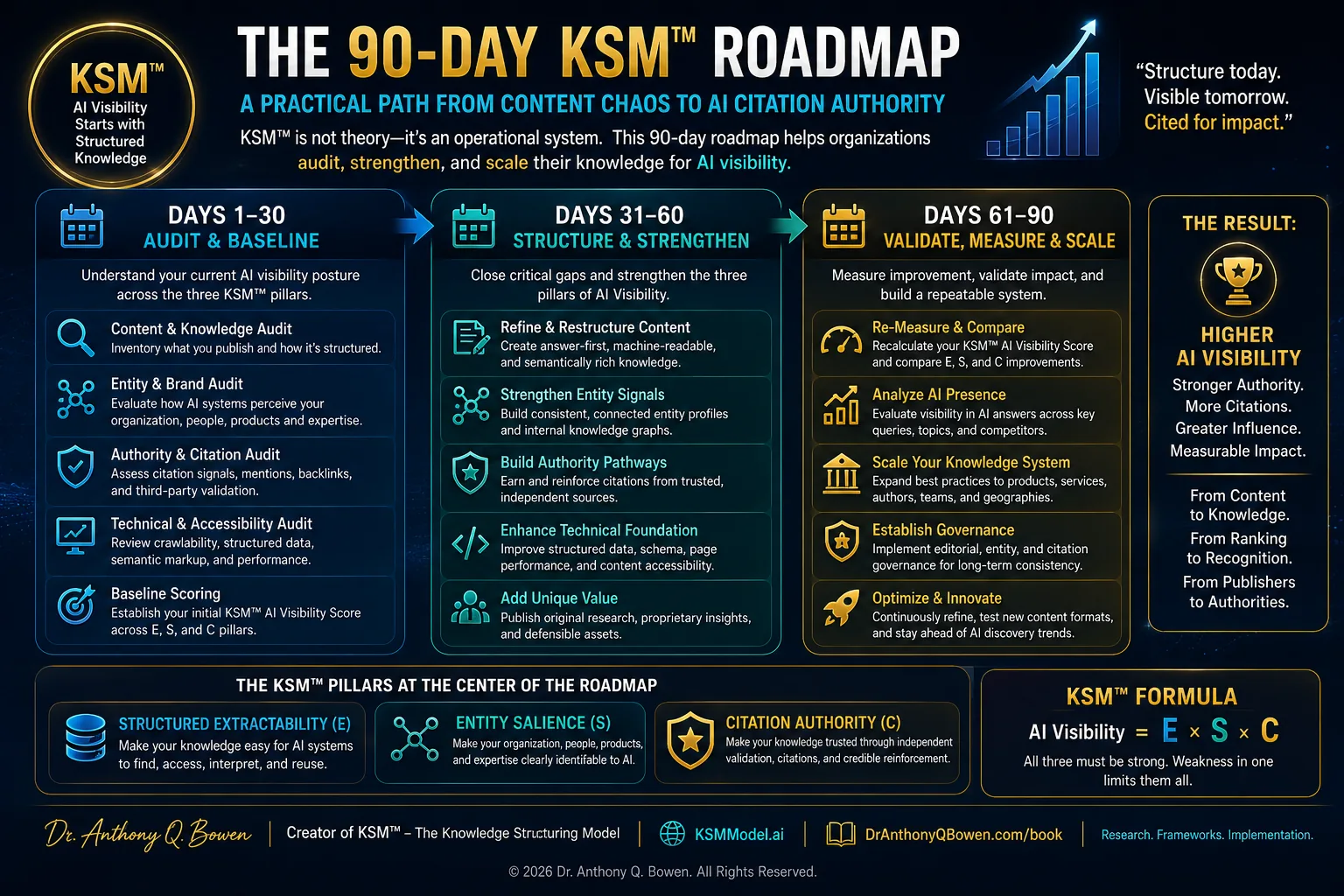
Turning KSM™ Into a 90-Day Implementation Roadmap
The experiment helped translate the theoretical framework into three practical implementation phases.
Days 1–30: Audit & Baseline
The first phase establishes what AI systems can currently see and understand.
Audit:
Content and Knowledge
- What does the organization actually publish?
- Is important knowledge buried in long-form prose, PDFs, JavaScript applications, disconnected pages, or poorly structured repositories?
Entity Representation
- Are the organization, executives, products, research, services, expertise, and intellectual property consistently represented?
Citation Authority
- What independent sources support important claims?
- Where are citations, research publications, institutional references, media mentions, backlinks, and third-party validation coming from?
Technical Accessibility
- Can machines efficiently access and interpret important content?
- Are structured data, semantic markup, page architecture, metadata, crawlability, and accessibility supporting or hindering extraction?
AI Presence
- How does the organization currently appear across relevant AI-generated answers?
“The purpose of Phase 1 is to establish an AI Visibility baseline.”
Days 31–60: Structure & Strengthen
Once the gaps are visible, the second phase focuses on strengthening the three KSM™ pillars.
Content can be rewritten into clearer, answer-first knowledge structures.
Important concepts can receive dedicated pages.
Structured data can clarify entities and relationships.
Research can be connected explicitly to its author and underlying framework.
Executive profiles can be aligned.
Internal linking can connect related knowledge assets.
Original research, evidence, and defensible expertise can strengthen authority.
publishing isolated pages
building an interconnected knowledge system
Days 61–90: Validate, Measure & Scale
The third phase returns to measurement.
The organization:
- Retests important questions across AI environments
- Reviews entity representation
- Evaluates citation pathways
- Validates structured content
- Documents changes in visibility and representation
Successful interventions can then scale across:
- Topics
- Products
- Executives
- Research
- Services
- Business units
- Geographies
- Organizational knowledge domains
Governance becomes important at this stage because without governance organizations can gradually recreate the fragmentation the implementation was designed to correct.
What Changed During Those 90 Days?
Perhaps the most significant outcome was not one individual ranking, citation, or technical improvement.
It was the evolution of KSM™ itself.
Research
The original KSM™ framework established the theoretical foundation.
Book
AI Visibility, AEO & GEO: Understanding the Knowledge Structuring Model (KSM™) translated the framework for practitioners, executives, marketers, AI professionals, and digital strategists.
Assessment Methodology
The three pillars were translated into measurable dimensions organizations can audit and benchmark.
90-Day Implementation Roadmap
The research became an operational sequence organizations can use to diagnose, remediate, validate, and scale AI Visibility.
Technology
KSMModel.ai began translating the methodology into an accessible technology and assessment environment.
Professional Education
KSM™ became the foundation for educational and professional-development material around AI Visibility, AEO, GEO, structured knowledge, and enterprise AI strategy.
Industry Applications
The framework began being explored across different organizational environments rather than remaining limited to general digital marketing.
AI Visibility Was Only the Beginning
KSM™ originally focused primarily on an external problem:
“Can AI find, understand, trust, and cite organizational knowledge?”
But enterprises are increasingly deploying AI internally.
Retrieval-Augmented Generation, enterprise copilots, knowledge assistants, multi-agent architectures, and Agentic AI systems must work with internal organizational knowledge.
These systems require knowledge they can:
- Retrieve.
- Interpret.
- Relate.
- Validate.
- Reason over.
- Act upon.
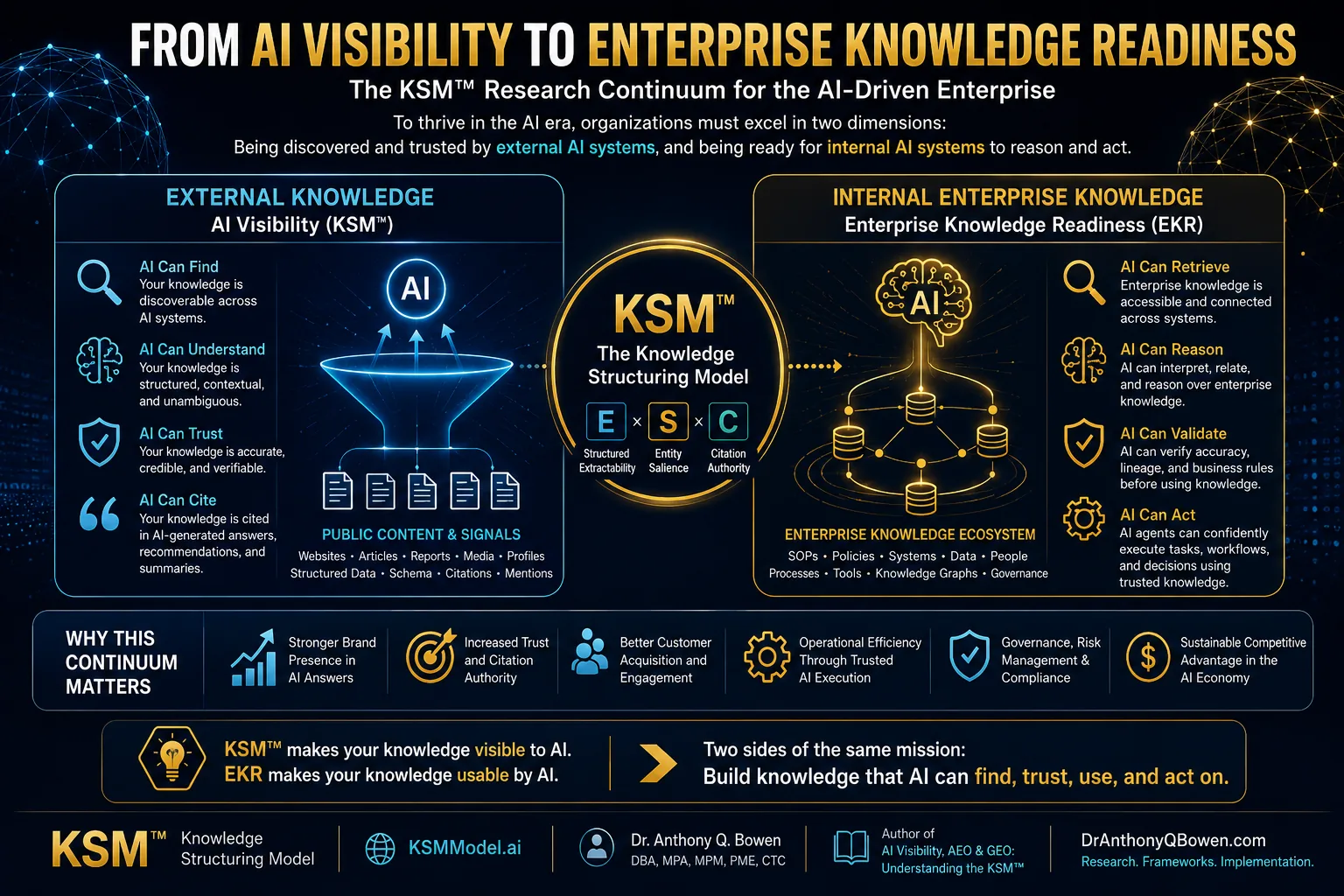
This led me to extend the original KSM™ research toward Enterprise Knowledge Readiness (EKR).
My subsequent research, Beyond AI Visibility: Extending the Knowledge Structuring Model (KSM™) to Enterprise Knowledge Readiness (EKR) for Agentic Artificial Intelligence, examines whether the organizational capabilities identified through KSM™ have broader significance as enterprises prepare knowledge for autonomous AI.
KSM™
Find → Understand → Trust → Cite
EKR
Retrieve → Reason → Validate → Act
Enterprise Content Is Becoming Enterprise Knowledge
One of my strongest conclusions from the first 90 days is that organizations need to reconsider what they call “content.”
A research paper is not simply content.
A methodology is not simply content.
Executive expertise is not simply content.
A validated case study is not simply content.
A proprietary dataset is not simply content.
A product specification is not simply content.
These are knowledge assets.
When properly structured, connected, attributed, supported, and governed, they can become part of an organization’s machine-readable knowledge architecture.
“How much should we publish?”
“What proprietary knowledge do we possess, and have we made it understandable, attributable, authoritative, and citable?”
What This Means for Marketing Leaders
Marketing organizations should not abandon SEO. They should expand beyond it.
AI-mediated discovery increasingly requires coordination across:
- SEO
- AEO
- GEO
- Structured data
- Content strategy
- Corporate communications
- Reputation management
- Digital PR
- Research
- Knowledge management
- Entity management
- AI strategy
KSM™ provides an architecture for connecting those activities around a common objective:
“Building knowledge that machines can understand and trust.”
What This Means for Enterprise AI Leaders
For CIOs, CTOs, CDOs, Chief AI Officers, knowledge leaders, and enterprise architects, the implications extend further.
AI performance will increasingly depend on the quality of the knowledge environment surrounding the model.
A sophisticated model operating over fragmented, contradictory, inaccessible, poorly governed enterprise knowledge remains constrained by that knowledge.
“Which AI model should we deploy?”
“Is our organizational knowledge ready for AI to reason and act upon?”
KSM™, EKR and Warrant Clearing
This progression also connects with my research with Jabran Chaudry on Warrant Clearing for Artificial Intelligence Agents.
KSM™ focuses on preparing knowledge so machines can discover and interpret it.
EKR extends that challenge into the enterprise knowledge environment.
Warrant Clearing addresses another critical dimension: maintaining relationships among claims, evidence, provenance, context, and justification as autonomous reasoning progresses.
“KSM™ prepares enterprise knowledge for machine consumption. Warrant Clearing preserves the integrity of that knowledge throughout autonomous reasoning and execution.”
The future AI enterprise needs knowledge that is structured, identifiable, attributable, trustworthy, governed, and usable.
What Comes After the First 90 Days?
The next stage includes:
- Continued empirical testing
- Industry-specific KSM™ applications
- Enterprise AI Visibility benchmarking
- Development of EKR
- Knowledge governance
- Agentic AI readiness
- Implementation playbooks
- Assessment methodologies
- Continued research into trustworthy autonomous AI
The objective is not to replace SEO, AEO, GEO, knowledge management, or AI governance.
It is to provide a framework connecting them around an emerging organizational challenge:
“How do we structure knowledge for a world in which Artificial Intelligence increasingly mediates what people discover, what organizations know, what machines trust, and eventually what autonomous systems do?”
90 Days Later
Ninety days ago, KSM™ began as an attempt to answer a research question.
Today, it is developing into a framework for approaching a much broader transformation.
“AI Visibility is not simply a marketing problem. It is a knowledge problem.”
“Enterprise AI readiness will increasingly become a knowledge-readiness problem.”
The organizations that understand this early have an opportunity to move beyond optimizing individual pieces of content and begin building something far more durable: a trusted enterprise knowledge architecture for the AI era.
Continue with the research
Explore the KSM™ Research
The Knowledge Structuring Model (KSM™): A Socio-Technical Framework for AI-Mediated Visibility and Citation Authority established the research foundation for the KSM™ framework.
Read the KSM™ ResearchExplore the Book
AI Visibility, AEO & GEO: Understanding the Knowledge Structuring Model (KSM™)
The book translates the KSM™ research into a practical framework for marketing leaders, SEO professionals, digital strategists, knowledge-management professionals, AI leaders, executives, and organizations preparing for AI-mediated discovery.
Explore the BookMeasure Your AI Visibility
Evaluate AI Visibility through the three KSM™ pillars: Structured Extractability, Entity Salience, and Citation Authority.
Take the AI Visibility AssessmentContinue to Enterprise Knowledge Readiness
Explore the extension of KSM™ from external AI Visibility toward enterprise knowledge environments supporting RAG, enterprise copilots, and Agentic AI.
Read the EKR ResearchUnderlying research
- Bowen, A. Q. (2026). The Knowledge Structuring Model (KSM™): A Socio-Technical Framework for AI-Mediated Visibility and Citation Authority. SSRN Electronic Journal. SSRN 6721140 · https://doi.org/10.5281/zenodo.20766821
- Bowen, A. Q., & Chaudry, J. I. (2026). Warrant Clearing for Artificial Intelligence Agents: Maintaining Justified Claims Across Recursive Agentic Synthesis. SSRN Electronic Journal. SSRN 6899418 · https://doi.org/10.2139/ssrn.6899418
- Bowen, A. Q. (2026). Beyond AI Visibility: Extending the Knowledge Structuring Model (KSM™) to Enterprise Knowledge Readiness (EKR) for Agentic Artificial Intelligence. SSRN Electronic Journal. SSRN 7113181 · https://doi.org/10.5281/zenodo.21680112
About the author

Dr. Anthony Q. Bowen is an executive AI strategist, researcher, author, educator, and creator of the Knowledge Structuring Model (KSM™) and Enterprise Knowledge Readiness (EKR).
His research examines AI Visibility, structured enterprise knowledge, Agentic Artificial Intelligence, AI governance, digital transformation, knowledge architecture, and the evolving relationship between organizations and intelligent systems.
He is the author of AI Visibility, AEO & GEO: Understanding the Knowledge Structuring Model (KSM™) and co-author with Jabran Chaudry of research addressing Warrant Clearing for Artificial Intelligence Agents.
90 Days of KSM™: FAQ
What is the Knowledge Structuring Model (KSM™)?
The Knowledge Structuring Model (KSM™) is a socio-technical framework created by Dr. Anthony Q. Bowen that conceptualizes AI Visibility as a function of three interdependent capabilities: Structured Extractability (can AI understand you?), Entity Salience (can AI recognize you?), and Citation Authority (can AI trust you?). AI Visibility = f(Structured Extractability × Entity Salience × Citation Authority). The model was introduced May 5, 2026 and posted to SSRN May 15, 2026 as SSRN 6721140.
What happened during 90 Days of KSM™?
After publishing KSM™, Dr. Bowen applied the framework to his own digital knowledge ecosystem — website, research, publications, book, structured data, and citations. The 90-day experiment revealed that publishing knowledge is not the same as structuring knowledge. The framework evolved from academic research into a practical system: KSM™ AI Visibility Assessment, 90-Day Implementation Roadmap (Audit & Baseline Days 1-30, Structure & Strengthen Days 31-60, Validate Measure & Scale Days 61-90), book, technology platform at ksmmodel.ai, and foundation for Enterprise Knowledge Readiness (EKR).
What are the three pillars of KSM™ AI Visibility?
1. Structured Extractability: Can AI systems access, extract, interpret, and reuse your knowledge? 2. Entity Salience: Can AI accurately determine who you are, what you do, and how your people, products, research, and ideas relate? 3. Citation Authority: Does sufficient credible evidence exist for AI to trust and cite your knowledge? The relationship is multiplicative — weakness in one pillar constrains overall visibility.
What is Enterprise Knowledge Readiness (EKR)?
Enterprise Knowledge Readiness (EKR) is the extension of KSM™ from external AI Visibility to internal enterprise knowledge environments. While KSM™ focuses on Find → Understand → Trust → Cite, EKR focuses on Retrieve → Reason → Validate → Act for systems like RAG, enterprise copilots, and Agentic AI. It is detailed in Bowen (2026) SSRN 7113181: Beyond AI Visibility: Extending KSM™ to Enterprise Knowledge Readiness for Agentic AI.
What is Warrant Clearing and how does it relate to KSM™?
Warrant Clearing for AI Agents, co-authored by Bowen & Chaudry (SSRN 6899418), addresses maintaining relationships among claims, evidence, provenance, and justification during autonomous reasoning. KSM™ prepares enterprise knowledge for machine consumption, EKR prepares internal knowledge for reasoning, and Warrant Clearing preserves integrity throughout execution.
What was the initial KSM™ self-audit score?
The 90-day self-audit of dranthonyqbowen.com on August 19, 2026 scored 74/100 weighted: Structured Extractability 93/100 (40% weight) with 8/8 valid Rich Results items, Entity Salience 69/100 (40% weight) with 10 verified sameAs profiles linked to one @id, and Citation Authority 44/100 (20% weight) with DOI and SSRN identifiers but early-stage third-party citation volume.