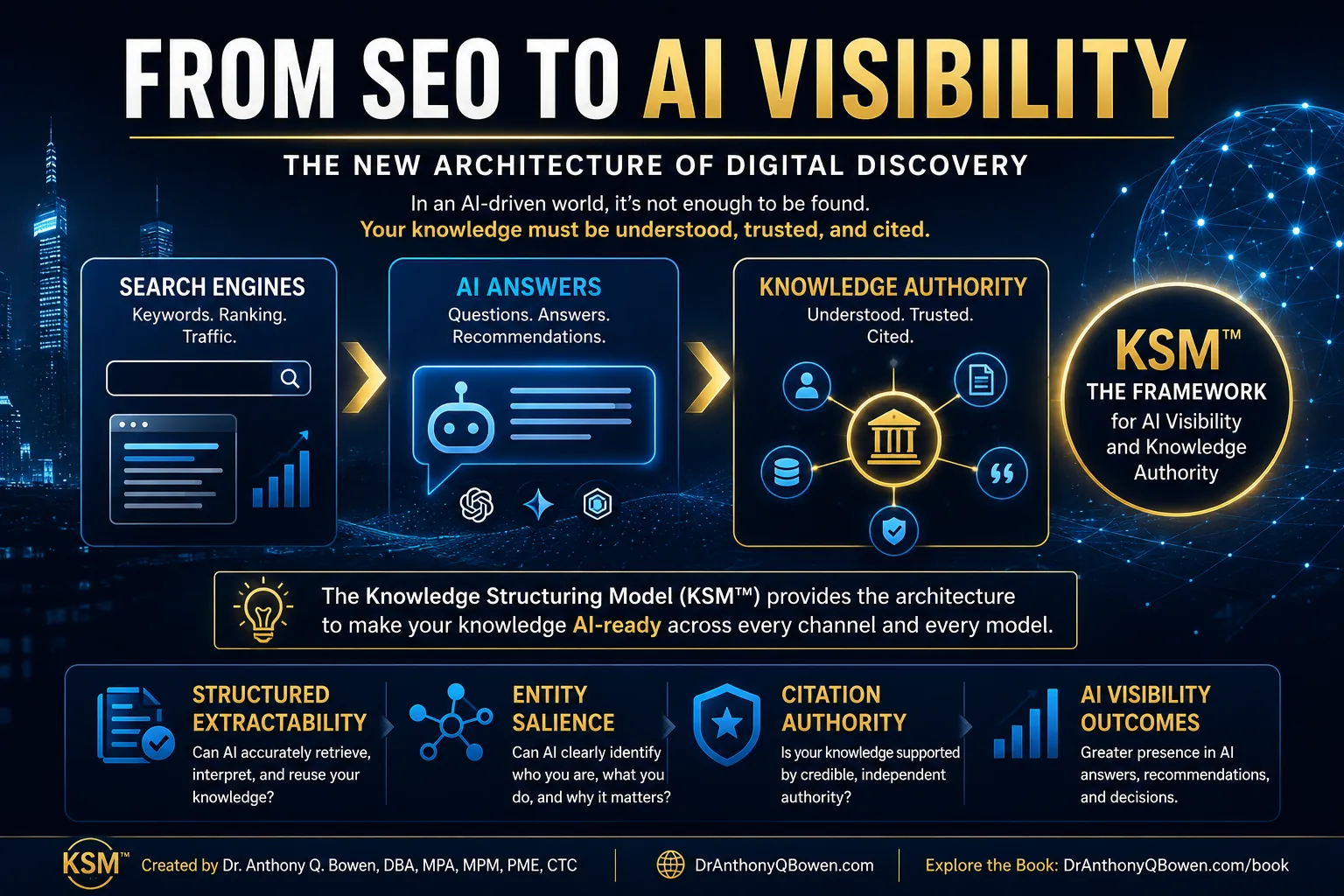
KSM™ Research Program

Research Advancing the Future of AI Visibility, Knowledge Management, and Agentic AI

Dr. Anthony Q. Bowen develops research that bridges academic theory with enterprise practice — helping organizations structure knowledge for AI, improve AI visibility, strengthen enterprise AI governance, and build trustworthy Agentic AI systems.

The portfolio includes the Knowledge Structuring Model™ (KSM™), AI Visibility, Warrant Clearing, and emerging enterprise AI frameworks.

The Research Program

The KSM™ Research Ecosystem

An evolving body of research advancing AI-native knowledge systems.

1

Knowledge Structuring

Organize information for machine reasoning.

2

Entity Alignment

Bind concepts to canonical identifiers.

3

Authority

Establish trust signals and citation weight.

4

AI Understanding

Enable retrieval and correct interpretation.

5

AI Visibility

Be cited, recommended, and acted upon.

Research Extension · Warrant Clearing

KSM™ and Warrant Clearing are separate but complementary. KSM™ structures knowledge upstream; Warrant Clearing preserves justification, provenance, contradictions, and constraints during recursive agentic reasoning. Warrant Clearing is not a stage in the KSM™ Maturity Model.

Warrant Clearing for Agentic AI infographic: Warrant Clearing operates at the agentic reasoning layer, complementing KSM™, which operates upstream at the knowledge-creation, structuring, and indexing layer. It is not a stage in the KSM™ Maturity Model.
KSM™ and Warrant Clearing: separate but complementary layers within an integrated epistemic integrity architecture.
Applied Research in Progress

The KSM™ Multi-Vertical SMB AI Visibility Study

Dr. Anthony Q. Bowen is leading a longitudinal applied research program examining whether the Knowledge Structuring Model produces measurable improvements in AI visibility across small and midsized businesses operating in different industries.

Each implementation uses a standardized baseline and 30-, 60- and 90-day reassessment process. The research measures changes in the overall KSM™ AI Visibility Score and its three interdependent pillars: Structured Extractability, Entity Salience and Citation Authority.

The study is designed to evaluate the repeatability and cross-vertical applicability of KSM™. It does not assume or claim that the framework has already been independently validated.

Primary Research Question

Can KSM™ operate as a repeatable, industry-agnostic framework for measuring and improving AI visibility across diverse SMB verticals?

Study Design

1

Standardized Baseline

A frozen Day 0 assessment establishes the organization’s starting KSM™ AI Visibility Score and individual pillar scores.

2

Longitudinal Measurement

Each implementation is reassessed at defined 30-, 60- and 90-day checkpoints.

3

Multi-Vertical Application

The same core methodology is applied across businesses with different audiences, knowledge structures, regulatory conditions and conversion models.

4

Evidence Before Claims

Observed results, future checkpoints and unmeasured outcomes remain clearly separated. Findings will inform a future scholarly article.

Validation Pathway

  1. Alpha Implementation

    dranthonyqbowen.com
    Executive authority and research ecosystem

    Founder-controlled environment used to develop and refine the KSM™ methodology.

  2. External Beta Implementation

    sonianoel.com
    Fashion and designer brand

    Currently entering the Day 60 measurement stage.

  3. First Paid Client Deployment

    peptidedoc.com
    Physician-led healthcare

    A 90-day commercial implementation measuring AI visibility in a regulated SMB environment.

  4. Expanded Multi-Vertical Cohort

    Planned verticals

    Planned verticals include nurse practitioner services, luxury real estate, technology SaaS, luxury-property rentals, film and television production accommodation, and corporate and event rentals.

Research Outcomes

  • Change in the overall KSM™ AI Visibility Score
  • Change within each KSM™ pillar
  • Correct entity recognition
  • Factual accuracy of AI-generated descriptions
  • Citation frequency and source authority
  • Branded and non-branded prompt visibility
  • Share of Model across a controlled prompt set
  • AI-referred traffic and qualified inquiries, where available
  • Cross-vertical consistency of observed results

Research collaboration and multi-vertical participation

Dr. Bowen welcomes scholarly collaboration and conversations with qualified SMBs interested in structured, evidence-based AI visibility measurement.

Research Timeline

A published foundation. A committed roadmap.

  1. 2026
    Knowledge Structuring Model™
  2. 2026
    AI Visibility
  3. 2026
    Warrant Clearing
  4. 2026
    Enterprise Knowledge Readiness (EKR)
How the Research Connects

KSM™ at the center of enterprise AI thought

KSM™Knowledge StructuringModel
AI Visibility
Agentic AI
Enterprise AI
Knowledge Management
Knowledge Graphs
Responsible AI
AI Governance
Explainable AI
Digital Transformation
Latest Publications

Research, Articles and Working Papers

Site Article

The Architecture of Digital Visibility Is Changing: From SEO to AI Visibility

Bowen, A. Q. (2026) · dranthonyqbowen.com
Read
90 Days of KSM Knowledge Structuring Model implementation journey from research to framework, implementation, measurement and evidence.
AI Visibility / KSM™

90 Days of KSM™: I Built the Framework, Then Put It Through Its Own Test

Dr. Anthony Q. Bowen · dranthonyqbowen.com

Ninety days after introducing the Knowledge Structuring Model (KSM™), Dr. Anthony Q. Bowen examines what happened when he applied the framework to his own digital knowledge ecosystem—and how the experiment helped transform KSM™ from academic research into an AI Visibility assessment, implementation roadmap, book, technology platform, and foundation for Enterprise Knowledge Readiness.

Read
LinkedIn Article

Unlocking AI Visibility: Why Organizations Need the Knowledge Structuring Model (KSM™)

Dr. Anthony Q. Bowen · LinkedIn
Read
  • Knowledge Structuring Model™

    Bowen, A. Q. (2026) · SSRN eJournal distribution · Abstract ID 6721140 · Archived on Zenodo (10.5281/zenodo.20766821)
    Read
  • Warrant Clearing for Artificial Intelligence Agents

    Chaudry, J., & Bowen, A. Q. (2026) · SSRN eJournal distribution · DOI: 10.2139/ssrn.6899418
    Read
  • Beyond AI Visibility: Extending KSM™ to Enterprise Knowledge Readiness (EKR)

    Bowen, A. Q. (2026) · SSRN eJournal distribution · Abstract ID 7113181 · Archived on Zenodo (10.5281/zenodo.21680112)
    Read
  • Knowledge Provenance for Agentic AI

    Bowen, A. Q. (Forthcoming) · In preparation
    Coming Soon
How to Cite This Work

Canonical citations for the KSM™ research program.

Use these references when citing KSM™, EKR, or Warrant Clearing in academic, analyst, or enterprise work.

KSM™

Bowen, A. Q. (2026). The Knowledge Structuring Model (KSM™): A Socio-Technical Framework for AI-Mediated Visibility and Citation Authority. SSRN Electronic Journal, Abstract ID 6721140. https://www.ssrn.com/abstract=6721140. Archived on Zenodo: https://doi.org/10.5281/zenodo.20766821.

EKR

Bowen, A. Q. (2026). Beyond AI Visibility: Extending the Knowledge Structuring Model (KSM™) to Enterprise Knowledge Readiness (EKR) for Agentic Artificial Intelligence. SSRN Electronic Journal, Abstract ID 7113181. https://www.ssrn.com/abstract=7113181. Archived on Zenodo: https://doi.org/10.5281/zenodo.21680112.

Warrant Clearing

Chaudry, J., & Bowen, A. Q. (2026). Warrant Clearing for Artificial Intelligence Agents: Maintaining Justified Claims Across Recursive Agentic Synthesis. Zenodo. https://doi.org/10.2139/ssrn.6899418.

Research Impact

What this research enables for the enterprise.

Trustworthy AI

Helping organizations build AI systems that are transparent, explainable, and verifiable.

Enterprise AI Governance

Supporting responsible AI deployment through structured knowledge and justified reasoning.

AI Visibility

Helping organizations become understood, cited, and recommended by AI systems.

Knowledge Advantage

Creating measurable competitive advantage through AI-native knowledge architecture.

JustifiedAnswers
Why This Matters

The future of AI is not only about generating answers.

It is about generating answers that are trustworthy, explainable, supported, and justifiable. The KSM™ research program addresses both challenges:

  • 1
    How organizations structure knowledge for AI
  • 2
    How AI preserves the integrity of that knowledge

Together, these research streams create the foundation for trustworthy enterprise AI.

Research Metrics

A growing scholarly footprint.

Research Areas
4+
AI Visibility · KM · Agentic AI · Governance
Scholarly Papers
4
Peer-distributed via SSRN
Research Networks
4
Generative AI · Information Systems · Software Engineering · CS Education
Enterprise AI
AI Visibility
Knowledge Management
Collaborate

Interested in collaborating?

Dr. Anthony Q. Bowen works with universities, enterprises, government agencies, technology companies, and research organizations to advance AI Visibility, Agentic AI, and Enterprise AI Governance.