The Architecture of Digital Visibility Is Changing: From SEO to AI Visibility
by Dr. Anthony Q. Bowen, DBA — creator of the Knowledge Structuring Model (KSM™) ·
Digital visibility is no longer decided by rank. AI systems now answer questions directly, and inclusion in those answers depends on whether your knowledge is extractable, your entity is resolvable, and your source is citable. The Knowledge Structuring Model (KSM™) formalizes those three conditions as AI Visibility = f(Structured Extractability × Entity Salience × Citation Authority).
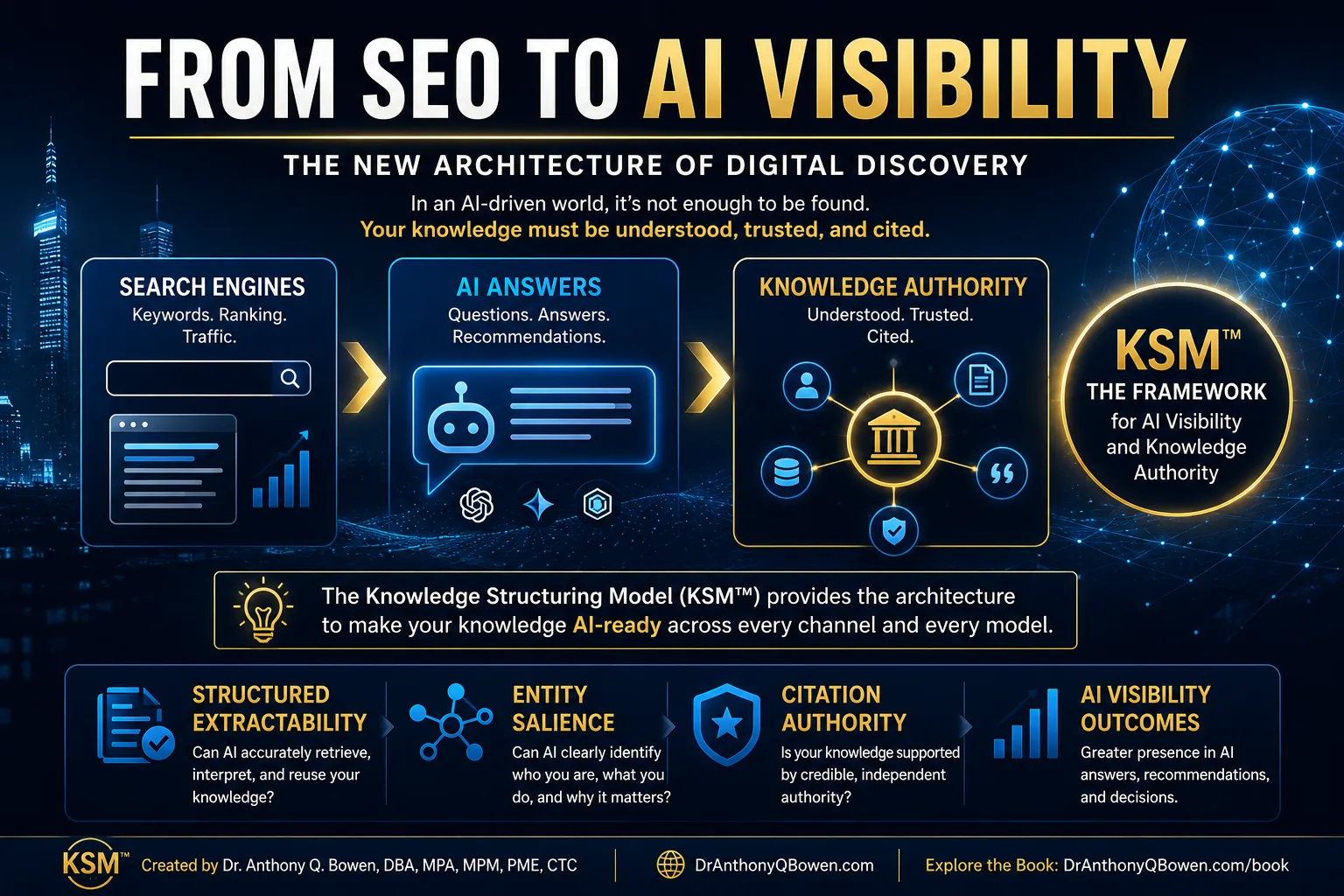
Search returned links. AI returns answers.
When an AI system answers a question, it synthesizes a response from sources it selected and, increasingly, attributes that response to a small number of them. The competition is no longer for a position in a list — it is for selection inside the answer itself.
For twenty-five years, digital strategy assumed a ranked results page: a query produced a list, a list produced clicks, and clicks produced outcomes. That assumption is dissolving. Generative and answer engines compress the list into a single synthesized response, and the majority of the underlying sources are never seen by the person who asked.
The strategic consequence is direct. Traffic-based measurement understates influence, because a brand can shape an answer without receiving a visit. Conversely, a well-ranked page can be entirely absent from generated answers if a model cannot isolate a usable claim from it or cannot resolve who is making the claim.
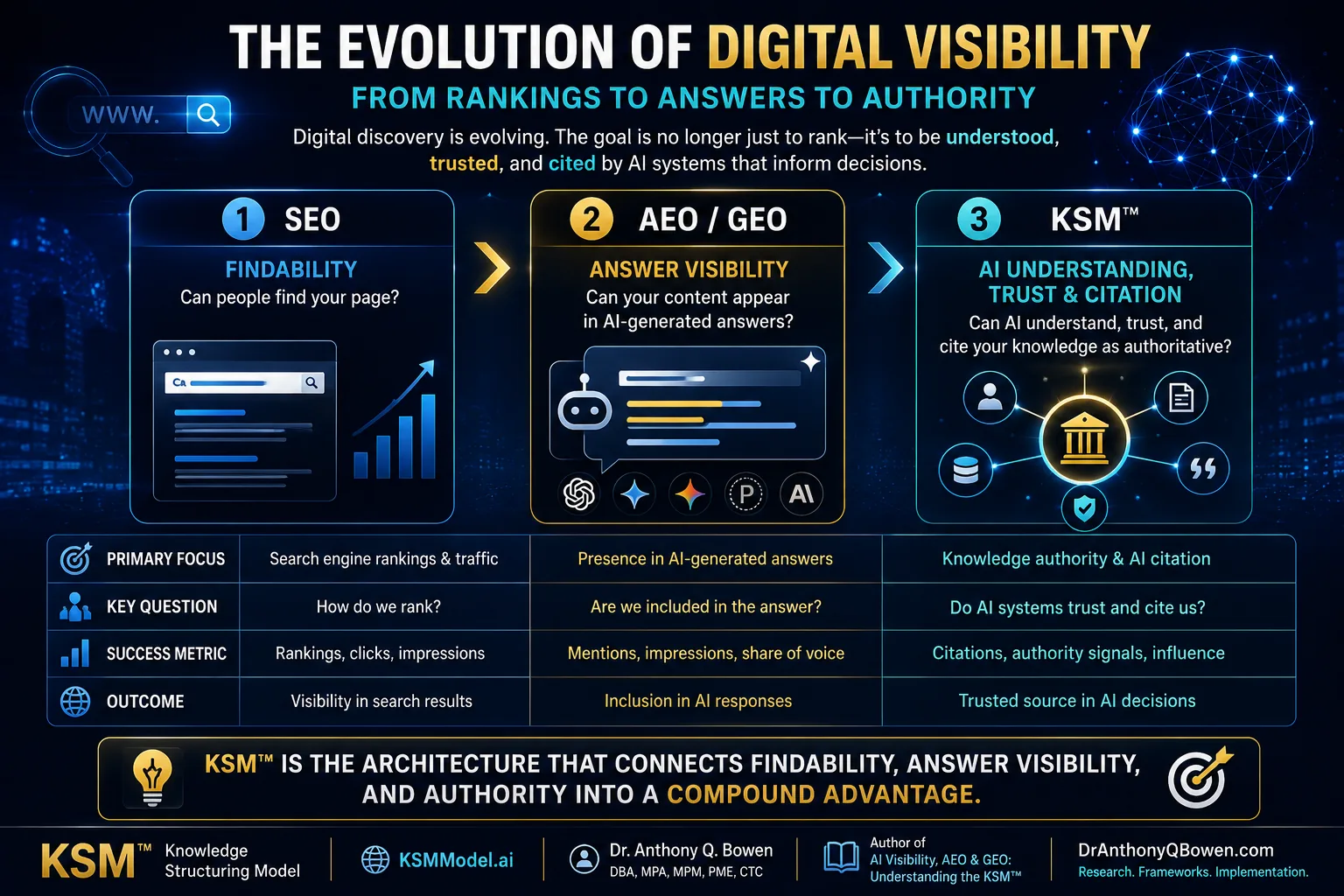
SEO, then AEO and GEO, then knowledge structuring.
SEO optimizes pages for ranking. AEO and GEO optimize content for answers. KSM™ structures knowledge itself for machine interpretation, entity resolution, and citation — the layer beneath both practices.
Search Engine Optimization (SEO) remains necessary: crawlability, indexation, and technical performance are the entry conditions. Answer Engine Optimization (AEO) narrows the goal to producing precise, self-contained responses that an answer engine can lift intact. Generative Engine Optimization (GEO) broadens it again to how generative systems represent, synthesize, and attribute a body of work.
KSM™ does not replace any of these. It supplies the framework they operate inside, by naming the three conditions that determine whether a machine can use your knowledge at all.
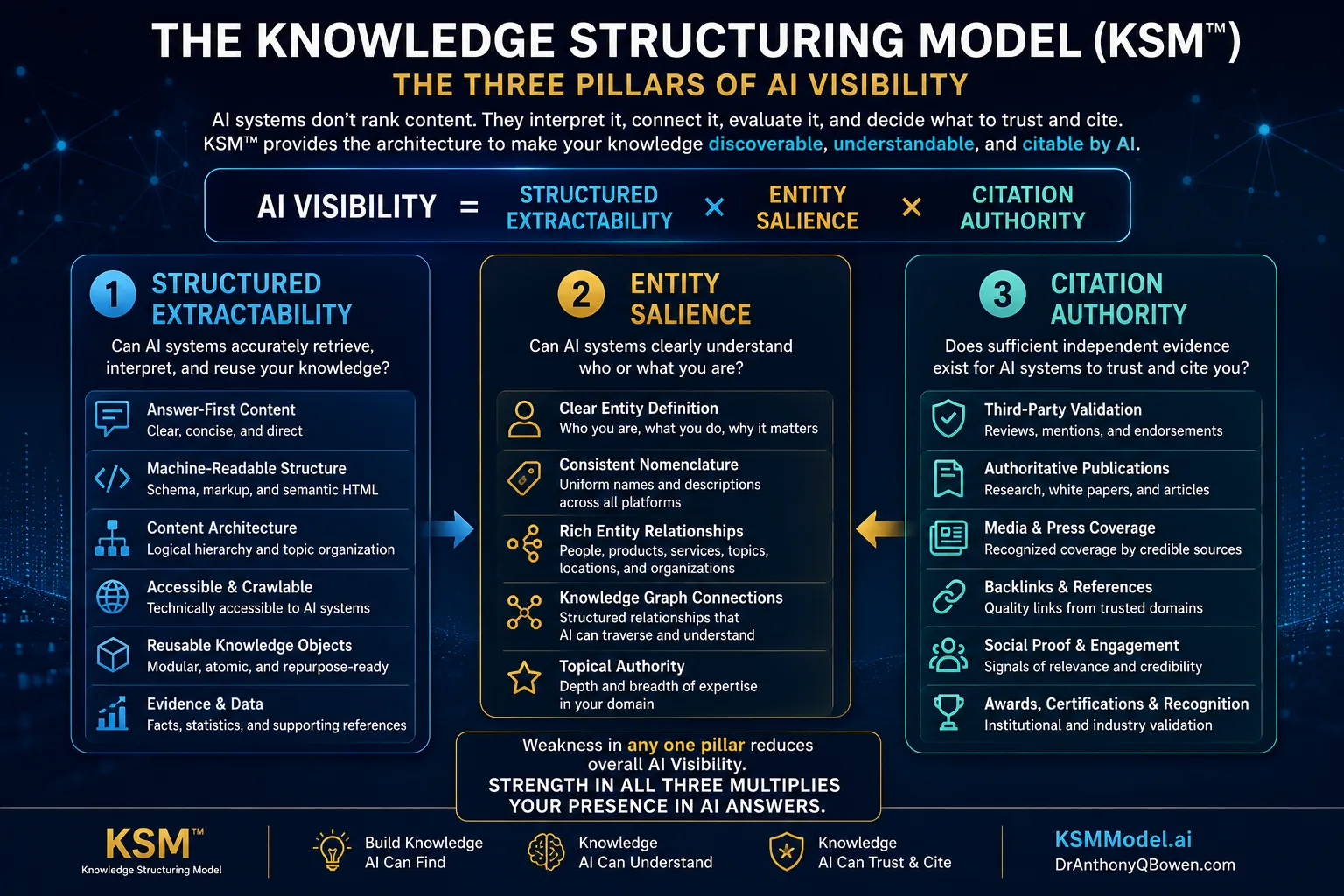
Three pillars: extractability, entity salience, citation authority.
The Knowledge Structuring Model (KSM™) states that AI Visibility = f(Structured Extractability × Entity Salience × Citation Authority), with SE, ES, and CA used as short labels for the three pillars. Because the relationship is multiplicative, a near-zero score on any one pillar collapses visibility regardless of strength in the others.
E — Structured Extractability
A machine can isolate a complete, self-contained claim from your source without needing the surrounding page. Answer-first paragraphs, unambiguous definitions, explicit units and dates, and accurate structured data all raise E.
S — Entity Salience
The person, organization, or concept behind the claim resolves consistently across sources. Persistent identifiers (ORCID, DOI), consistent naming, and reconciled profiles across authoritative repositories raise S.
C — Citation Authority
The accumulated warrant that makes a source safe to attribute: peer-reviewed or indexed publication, third-party citation, and durable archival records that a model can verify independently of your own website.
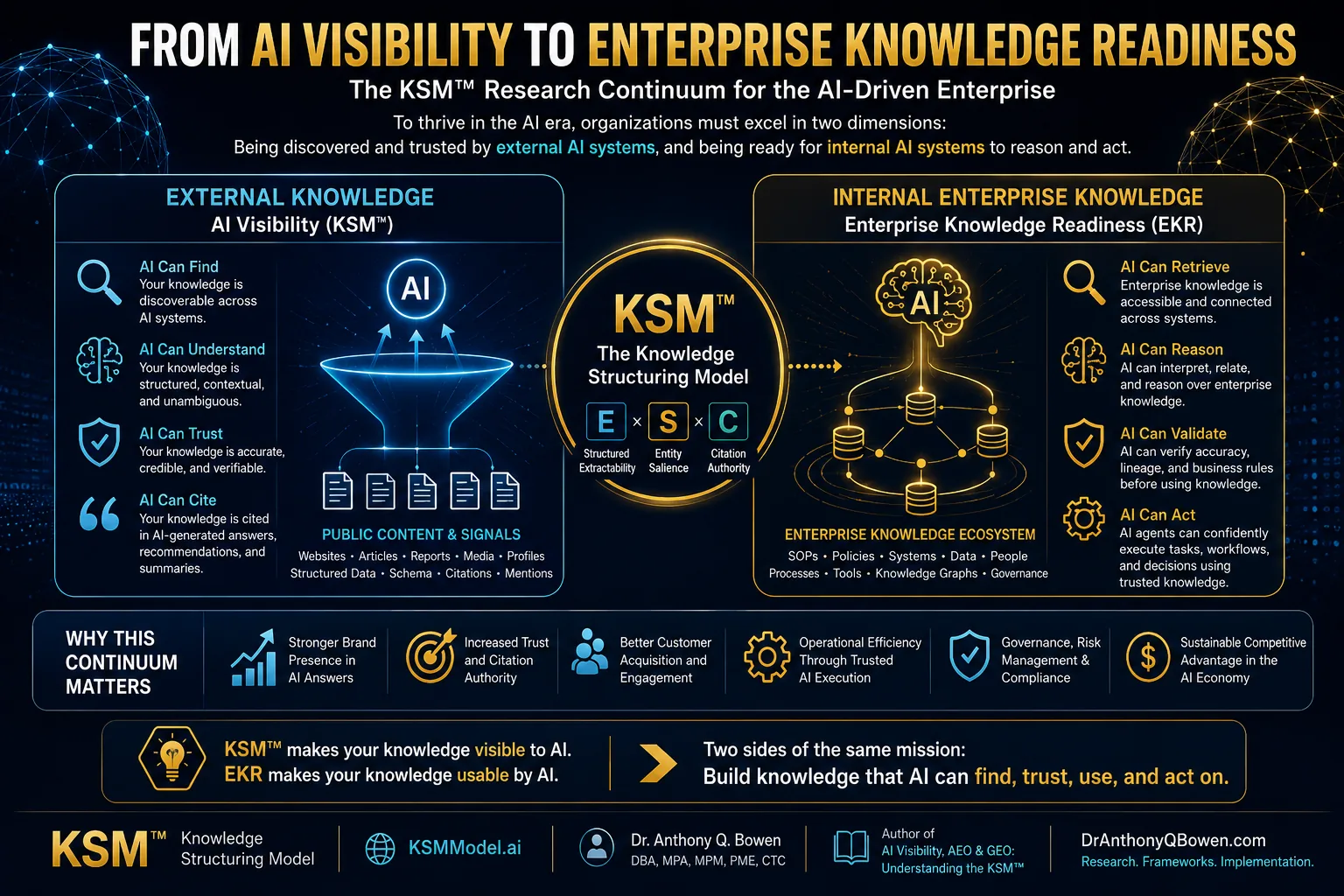
From external visibility to Enterprise Knowledge Readiness.
Enterprise Knowledge Readiness (EKR) applies the same three conditions inward. An organization deploying agentic AI on its own documentation faces an identical test: whether internal knowledge is extractable, entity-resolved, and warranted enough to be retrieved and acted upon safely.
Most enterprise AI failures are not model failures. They are knowledge failures — an agent retrieves an outdated policy, cannot distinguish two similarly named products, or propagates a claim whose justification was lost several synthesis steps back. That last problem is the subject of Warrant Clearing for Artificial Intelligence Agents.
The 90-Day KSM™ Roadmap.
Sequence matters. Diagnose the baseline first, then remediate structure, then consolidate entity signals, then build citation authority — attempting authority before extractability produces citations a machine cannot use.
Days 1–30 · Baseline
Score current extractability, entity resolution, and citation footprint. Identify which pillar is the binding constraint.
Days 31–60 · Structure
Rewrite key pages answer-first, add definitional statements, and correct structured data so claims can be lifted intact.
Days 61–75 · Entity
Consolidate naming, connect persistent identifiers, and reconcile profiles across authoritative repositories.
Days 76–90 · Authority
Publish citable artifacts in indexed venues and establish the third-party references that compound over time.
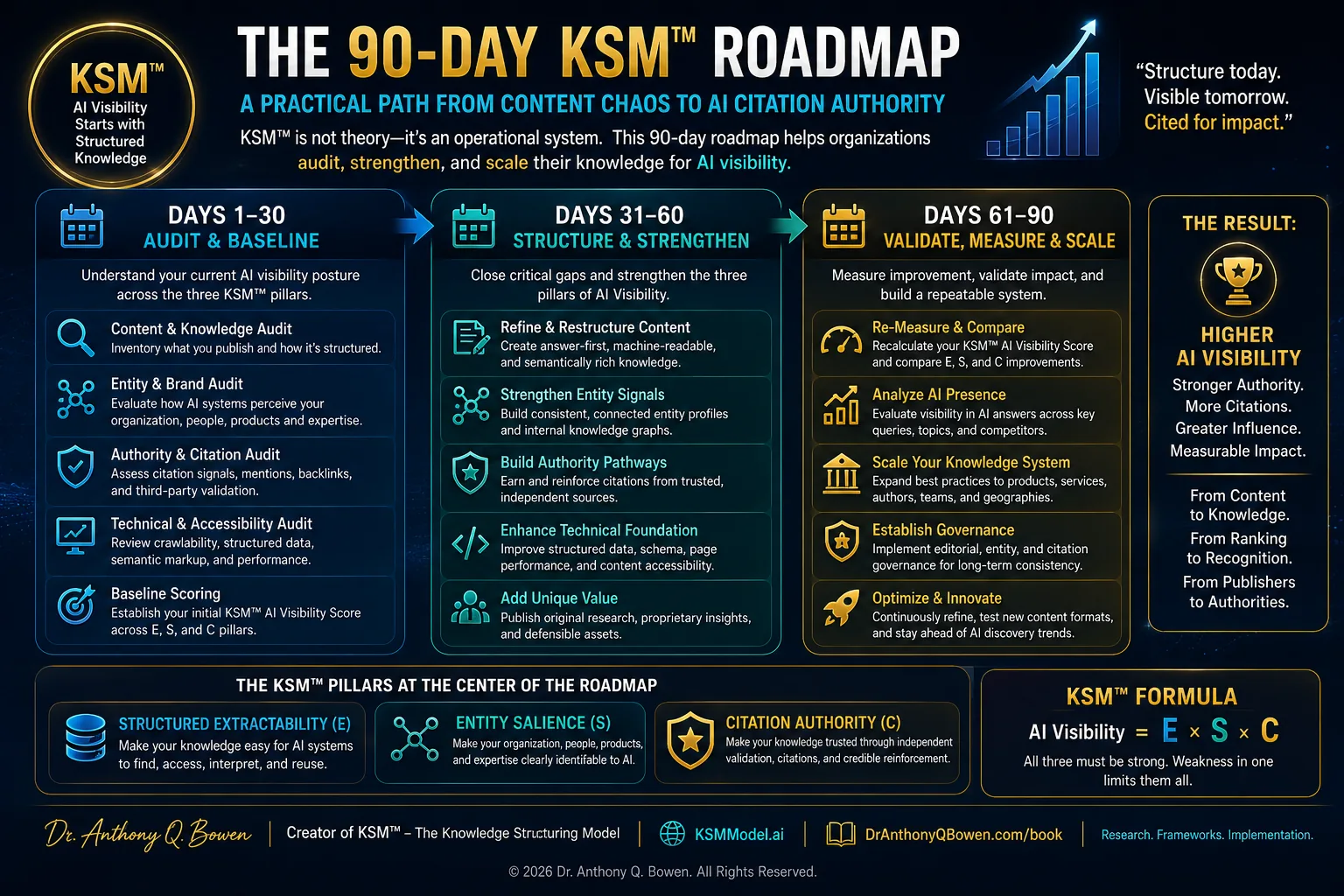
Start with the free KSM™ AI Visibility Baseline Score, or read the full framework in AI Visibility, AEO & GEO.
Questions about AI visibility and KSM™.
What is AI visibility?
AI visibility is the degree to which an organization, expert, or body of knowledge is understood, retrieved, and cited by AI systems when they generate answers. Unlike a search ranking, it is not a position on a results page — it is whether a model selects your knowledge as the source it synthesizes and attributes.
Is KSM™ a replacement for SEO?
No. The Knowledge Structuring Model (KSM™) extends SEO. SEO remains the discipline of being crawlable, indexable, and competitive in ranked results. KSM™ governs what happens after retrieval: whether a machine can extract a self-contained claim, resolve the entity behind it, and treat the source as citable.
What are the three pillars of KSM™?
Structured Extractability (SE), Entity Salience (ES), and Citation Authority (CA). AI Visibility = f(Structured Extractability × Entity Salience × Citation Authority). Because the relationship is multiplicative, a near-zero value on any single pillar collapses total visibility regardless of strength elsewhere.
What is Enterprise Knowledge Readiness (EKR)?
Enterprise Knowledge Readiness (EKR) applies the KSM™ conditions inward, to an organization's internal knowledge base. It measures whether internal documentation is extractable, entity-resolved, and warranted enough for agentic AI systems to retrieve and act on it reliably.
How long does it take to see results?
The 90-Day KSM™ Roadmap sequences a baseline assessment, structural remediation, entity consolidation, and citation authority development. Extractability and entity fixes surface fastest; citation authority compounds over quarters, not weeks.
The three-paper research program.
- Bowen, A. Q. (2026). The Knowledge Structuring Model: A Socio-Technical Framework for AI-Mediated Visibility and Citation Authority. SSRN Electronic Journal. SSRN 6721140 · https://doi.org/10.5281/zenodo.20766821
- Bowen, A. Q., & Chaudry, J. I. (2026). Warrant Clearing for Artificial Intelligence Agents: Maintaining Justified Claims Across Recursive Agentic Synthesis. SSRN Electronic Journal. SSRN 6899418 · https://doi.org/10.2139/ssrn.6899418
- Bowen, A. Q. (2026). Beyond AI Visibility: Extending the Knowledge Structuring Model (KSM™) to Enterprise Knowledge Readiness (EKR) for Agentic Artificial Intelligence. SSRN Electronic Journal. SSRN 7113181 · https://doi.org/10.5281/zenodo.21680112
Full research program: /research
Machine-readable knowledge graph (entities, relationships and citations): /knowledge-graph.jsonld