Executive AI Strategist
KSM™: A Framework for AI-Mediated Visibility and Citation Authority
Dr. Anthony Q. Bowen, DBA, PME, CIPM, MPM, MPA, CTC
Executive AI Strategist, creator of the KSM™ Framework (SSRN 6721140), and graduate faculty member at GCU; former Graduate Marketing Professor at SNHU and JWMI.
Professional Overview
A Career Built at the Intersection of AI, Strategy & Enterprise Transformation
Dr. Anthony Q. Bowen, DBA, PME, CIPM, MPM, MPA, CTC is a recognized AI strategist, digital transformation executive, published researcher, and graduate faculty member with 25+ years leading enterprise digital transformation, AI strategy, customer experience, analytics, and emerging technology initiatives across Fortune 500 organizations. Creator of the Knowledge Structuring Model (KSM™), a socio-technical framework for AI-mediated visibility, entity authority, and citation optimization in generative AI environments.
His career spans three distinct domains of executive practice: client-side Fortune 500 leadership, where he has held C-suite and senior executive roles driving enterprise-scale transformation; advertising agency and DTC brand strategy, where he has led integrated marketing, digital acquisition, and performance media initiatives; and digital engineering consulting, where he has architected and delivered large-scale technology modernization, cloud migration, and AI-driven platform solutions.
He currently serves as Executive Managing Consultant at Moral and AI Consultant to Fortune 500 Pharma and Finance companies. Former Advisor to Crewasis, advising organizations on AI adoption, enterprise transformation, Agentic AI, Answer Engine Optimization (AEO), Generative Engine Optimization (GEO), and AI-driven decision intelligence.
Throughout his career, Dr. Bowen has held executive leadership positions including COO, CDO, Head of AI Strategy, SVP, and VP of Digital Transformation across healthcare, pharmaceuticals, financial services, telecommunications, hospitality, travel, insurance, media, advertising, and enterprise technology sectors.
His leadership experience includes organizations such as Hilton Worldwide, Virtusa, Cablevision/Optimum, Altice USA, Ai Media Group (Blackstone Portfolio Company), Quantum Digital Media, Deutsche Bahn German Rail, Trafalgar Tours, Uniworld River Cruises, CheapOair/Fareportal, Moral, and Crewasis.
As a graduate MBA faculty member, Dr. Bowen teaches at Grand Canyon University (GCU) Colangelo College of Business, and formerly at SNHU, Queens College CUNY School of Professional Studies, and the Jack Welch Management Institute.
Executive AI Strategist · Researcher · Educator · Digital Transformation Leader — 25+ years shaping the future of enterprise AI and digital strategy.
Current Engagements
Leading AI Decision Intelligence at the Frontier
AI Strategy Consultant to Fortune 1000 companies.
Areas of Expertise
A Multidisciplinary Command of AI, Technology & Strategy
AI & Digital Strategy
- Enterprise AI Strategy
- Generative & Agentic AI
- AI Governance & Responsible AI
- LLM, RAG & Autonomous Agents
- AI Decision Intelligence
Marketing & CX
- Digital Transformation
- Customer Experience (CX)
- MarTech & AdTech
- AEO & GEO Strategy
- Marketing Automation
Enterprise Technology
- Adobe Experience Cloud
- Salesforce Ecosystem
- Azure, AWS, GCP
- Enterprise SaaS Platforms
- Data Governance & Analytics
Executive Leadership
- C-Suite Advisory
- Board Engagement
- Strategic Partnerships
- Global Delivery & Operations
- Product Innovation & Growth
Academic Leadership
Bridging Executive Practice & Graduate Education
Dr. Bowen's teaching philosophy is grounded in a single conviction: academic theory must connect directly to real-world executive decision-making. He equips future business leaders with the analytical frameworks and strategic fluency required to navigate AI, digital transformation, and organizational change.
Grand Canyon University (GCU)
Adjunct Faculty — MBA Marketing Management Program. Teaches graduate marketing strategy and digital marketing.
gcu.edu/faculty/anthony-bowenSouthern New Hampshire University (SNHU)
Former Adjunct Professor of Marketing and Project Management.
Jack Welch Management Institute (JWMI)
Former Adjunct Professor — Executive MBA Program.

Core Theory
The Knowledge Structuring Model (KSM™)
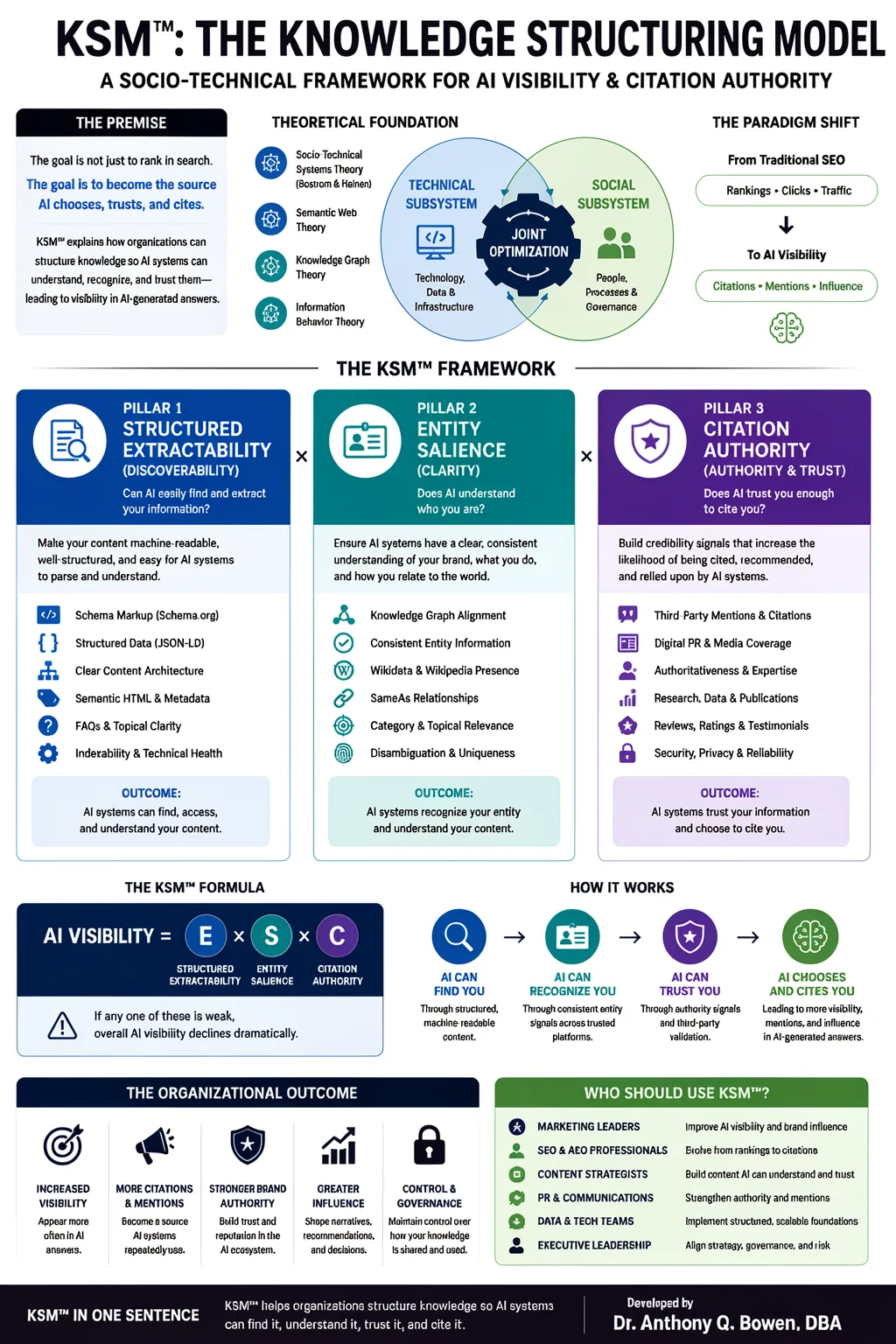
Developed by Dr. Anthony Q. Bowen, KSM™ is a socio-technical framework for AI-mediated visibility and citation authority. The model is theoretically grounded in Socio-Technical Systems (STS) Theory and informed by Semantic Web, Knowledge Graph, Information Behavior, and Information Retrieval perspectives.
KSM™ conceptualizes AI visibility as a function of Structured Extractability, Entity Salience, and Citation Authority Reinforcement — providing organizations with a practical roadmap for transitioning from traditional SEO to AI-native visibility strategies.

The KSM™ Formula
Three Questions That Determine AI Visibility
Pillar 1
Can AI understand you?
Pillar 2
Can AI recognize you?
Pillar 3
Can AI trust you?
"If the answer to any one of those questions is no, visibility suffers. Organizations can no longer rely solely on traditional SEO metrics. The future belongs to organizations that become trusted sources within AI systems." — Dr. Bowen
Bowen, Anthony. The Knowledge Structuring Model (KSM™): A Socio-Technical Framework for AI-Mediated Visibility and Citation Authority (May 05, 2026). Available at SSRN: www.ssrn.com/abstract=6721140
Publications
KSM™ Framework — Research Publications
Dr. Bowen's foundational research is posted on SSRN (Abstract 6721140) as a 13-page working paper, written May 5, 2026 and posted May 15, 2026. The paper is distributed across SSRN's curated eJournal networks — including Generative AI, Managerial Marketing, and Behavioral Marketing — and was featured in SSRN's Generative AI Special Topic Hub (Vol. 4, Issue 111).
Featured Article
The Architecture of Digital Visibility Is Changing: From SEO to AI Visibility
An answer-first walkthrough of the shift from search rankings to AI-generated answers — the three KSM™ pillars, the digital maturity curve, Enterprise Knowledge Readiness (EKR), and a 90-day roadmap.
Read the article →AI Visibility / KSM™
90 Days of KSM™: I Built the Framework, Then Put It Through Its Own Test
Ninety days after introducing the Knowledge Structuring Model (KSM™), Dr. Anthony Q. Bowen examines what happened when he applied the framework to his own digital knowledge ecosystem—and how the experiment helped transform KSM™ from academic research into an AI Visibility assessment, implementation roadmap, book, technology platform, and foundation for Enterprise Knowledge Readiness.
Read the article →SSRN / Zenodo — KSM™ Working Paper and Research Archive
Bowen, A. Q. (2026). The Knowledge Structuring Model (KSM™): A Socio-Technical Framework for AI-Mediated Visibility and Citation Authority. Available on SSRN, Abstract ID 6721140 (https://www.ssrn.com/abstract=6721140), and archived on Zenodo (https://doi.org/10.5281/zenodo.20766821).
The W.U.S.T. Review
Strategic AI for Business Leaders · Vol. 1, Issue 1 · Endorsed by Dean Dr. Mark Robinson, WUST. Highlights the practical application of KSM™ for executive decision-makers.
Warrant Clearing for Artificial Intelligence Agents
Chaudry, J., & Bowen, A. Q. (2026). Warrant Clearing for Artificial Intelligence Agents: Maintaining Justified Claims Across Recursive Agentic Synthesis. SSRN: https://www.ssrn.com/abstract=6899418. Distributed across CompSciRN Computer Science Education (Vol. 9, Issue 125 · June 30, 2026), CompSciRN Software Engineering (Vol. 9, Issue 151 · July 1, 2026), CompSciRN Information Systems (Vol. 9, Issue 191 · September 30, 2026), and InfoSciRN Generative AI (Vol. 4, Issue 125 · July 1, 2026).
Beyond AI Visibility: Extending KSM™ to Enterprise Knowledge Readiness (EKR)
Bowen, A. Q. (2026). Beyond AI Visibility: Extending the Knowledge Structuring Model (KSM™) to Enterprise Knowledge Readiness (EKR) for Agentic Artificial Intelligence. SSRN: https://www.ssrn.com/abstract=7113181. Archived on Zenodo: https://doi.org/10.5281/zenodo.21680112. Distributed across Entrepreneurship & Management (Vol. 21, Issue 143 · July 30, 2026), Management of Innovation (Vol. 14, Issue 137 · July 30, 2026), and Organizations & Markets: Policies & Processes (Vol. 12, Issue 136 · July 30, 2026), with distribution scheduled for Information Systems (November 24, 2026).
Press & Media Coverage
Research, Articles and Working Papers
International Media Coverage
KSM™ Executive Education Gains Spanish-Language International Coverage
IyMagazine · International Media ·
IyMagazine highlights Dr. Anthony Q. Bowen’s Knowledge Structuring Model (KSM™) and its expansion into executive education for universities, consulting firms, and enterprises.
Read Coverage →News & Announcements
KSMModel.ai Launches KSMModel.app to Score and Improve AI Visibility Across AEO and GEO
EIN Presswire · Official Press Release ·
Official announcement of KSMModel.app, an AI Visibility assessment platform built on Dr. Anthony Q. Bowen's Knowledge Structuring Model (KSM™), supporting Answer Engine Optimization (AEO) and Generative Engine Optimization (GEO).
Read the Article →KSMModel.ai Launches KSMModel.app to Score and Improve AI Visibility Across AEO and GEO
PIX11 New York · Distributed Press Release (EIN Presswire) ·
Syndicated placement of the EIN Presswire KSMModel.app launch release. Distributed press release, not an independent editorial article.
Read the Article →KSMModel.ai Launches KSMModel.app to Score and Improve AI Visibility Across AEO
The National Law Review · Distributed Press Release ·
Syndicated placement of the KSMModel.app launch release in The National Law Review's press-release section. Distributed press release, not an independent editorial article.
Read the Article →KSMmodel.ai Uses CBHerald.com Audit to Show How AI Visibility Strategy Becomes a 90-Day Action Plan
CB Herald · Press Release ·
Distributed release using a KSM™ audit of CBHerald.com itself as a working example of how an AI Visibility diagnosis becomes a 90-day cross-functional development roadmap, tied to the KSM™ Executive Education Program.
Read the Article →KSMmodel.ai Launches Executive Education Program for Universities, Consultants & Enterprises
EIN Presswire · Press Release ·
Announces the KSM™ Executive Education Program, an eight-week applied program bringing the Knowledge Structuring Model into universities, consulting firms, and enterprises.
Read the Article →KSMmodel.ai Launches the First Platform Built on a Unified Framework for AI Citation Visibility
OpenPR · Press Release ·
Coverage of the KSMmodel.ai platform launch, explaining how the Knowledge Structuring Model (KSM™) unifies AEO, GEO, and knowledge graph theory into a measurable framework, and how the platform turns Dr. Bowen's research into a live AI Visibility assessment tool.
Read the Article →Independent Application
Sonia Noel Celebrates 30 Years with Homecoming Business, Fashion Showcase
Guyana Times ·
Reports that Dr. Anthony Q. Bowen is scheduled to lead a special session at the Women in Business Expo (October 24–25, 2026), working with participating entrepreneurs on AI, digital visibility, and KSM™.
Read the Article →Women in Business Expo Returns for 10th Year
Guyana Chronicle ·
Coverage of the 10th Women in Business Expo, noting a scheduled developmental session facilitated by Dr. Anthony Q. Bowen, creator of the Knowledge Structuring Model (KSM™), on AI and business visibility.
Read the Article →Sonia Noel Embraces AI and KSM™ as Fashion Brand Prepares for New Era of Digital Discovery
Guyana Chronicle ·
Guyana Chronicle reports on the collaboration between Sonia Noel Inc. and Dr. Anthony Q. Bowen, creator of KSM™, to improve the organization's AI visibility through structured digital knowledge.
Read the Article →Sonia Noel leverages AI, knowledge structuring to lead fashion brand into new era of digital discovery
Guyana Times ·
Covers Sonia Noel's AI adoption ahead of her 30th-anniversary fashion celebration in Barbados, including her website rebuild around KSM™ principles guided by Dr. Anthony Q. Bowen, with original quotes from both Noel and Dr. Bowen on AI visibility, entity structuring, and Dr. Bowen's plans to bring KSM™ education to Guyana.
Read the Article →Sonia Noel Embraces AI and KSM™ as a Fashion Brand
Kaieteur News ·
As Guyanese fashion designer Sonia Noel marks 30 years in the industry, the piece covers how she's rebuilding her brand's site around KSM™ principles with guidance from Dr. Anthony Q. Bowen, and includes a direct quote from Bowen on structuring knowledge for AI-driven discovery.
Read the Article →Dr Anthony Q Bowen's KSM Model Playbook for Winery – AI Visibility in the AI Era
By Dr. Elinor Garely, Editor in Chief, InMyPersonalOpinion.Life ·
Dr. Garely applies the Knowledge Structuring Model™ to the wine industry, walking through how Knowledge Signals, Trust Signals, and Citation Signals determine whether AI systems recognize, trust, and accurately represent a winery — and outlines a practical implementation playbook for wineries adopting KSM™ principles.
Read the Article →Education & Credentials
Education, Certifications & Honors
Doctor of Business Administration (DBA)
Northcentral University — Project Management. Doctoral research on leadership, motivation, and project performance dynamics.
Master of Public Administration (MPA)
John Jay College, CUNY — Information Systems Management.
Bachelor of Science
York College, CUNY — Business Administration.
Honors & Academic Distinctions
- The National Society of Leadership and Success (Nov 2024) — Honored for leadership, community involvement, and academic excellence at Northcentral University.
- Delta Mu Delta International Honor Society in Business (Apr 2016) — Inducted for top-tier academic excellence in business administration.
- Golden Key International Honor Society (Apr 2016) — Elite membership reserved exclusively for the top 15% of graduate students at Northcentral University.
- Hilton Worldwide Circle of Excellence Award (Apr 2012) — Named Regional E-commerce Manager of the Year for driving over $200 Million in corporate online sales volume.
- Psi Chi International Honor Society in Psychology (Jun 1992) — Recognized for early academic excellence in behavioral sciences at York College, CUNY.
Certifications
- • Harvard EdX — Leadership & Communication
- • IBM EdX — Generative AI
- • IBM EdX — Prompt Engineering
- • AWS Cloud Technical Essentials
- • Columbia Business School — Digital Transformation Healthcare
- • NYU — Project Management
- • Cornell — Project Leadership
- • Rutgers — IT Management
- • American Academy of Project Management — MPM, PME, CIPM
Executive Education: Columbia Business School · Cornell University · NYU · Rutgers · Harvard edX · IBM AI Programs · AWS Cloud Technologies
Speaking Engagements
Conference Panels & Keynotes
Presented at national industry conferences across marketing technology, lead generation, and healthcare distribution — sharing the stage with C-suite executives and industry leaders.
January 4–6, 2026 · San Diego, CA
Lead Generation World 2026
From Awareness to Action: Marketing Creativity and Specialized Media Partnerships in TV Advertising
Panel: Costin Miclea (CMO, WebGrit), Andy Gass (Chief Strategy Officer, Viden), Elizabeth Stone (CEO, LizDev)
Role: Adjunct Faculty, Marketing Management, Grand Canyon University
April 2024 · Fontainebleau, Las Vegas
Medicarians 2024 — ACA Health Summit
The Latest CMS Compliance Protocol and How to Do It Efficiently
Panel: Joshua Brooker (NABIP), Al Castellanos (Premier Insurance Contracts), Josh Van Drei (CMS)
Role: COO & CDO, Quantum Digital Media
2019 · Las Vegas, NV
Adobe Summit 2019 — Session S968
Engaging Your B2B Audiences: How Cisco Meraki Drives Digital Transformation
Panel: Neal Hooks (Director of Global Web Marketing, Cisco-Meraki)
Role: Senior Director, Digital Solutions, Virtusa
KSM™ FAQs
KSM™ Model FAQs
Comprehensive answers about the Knowledge Structuring Model and its application in AI-mediated environments.
Comparison
KSM™ vs. Traditional SEO
SEO optimizes for search engine rankings. KSM™ optimizes for AI-mediated visibility. SEO remains important, but KSM™ extends beyond search into AI-generated environments.
| Traditional SEO | KSM™ AI Visibility |
|---|---|
| Rankings | Citations |
| Keywords | Entities |
| Backlinks | Authority Signals |
| Traffic | Inclusion in AI Answers |
| Retrieval | Synthesis |

The KSM™ Formula
AI Visibility = f(Structured Extractability × Entity Salience × Citation Authority)
SE
SE — Structured Extractability
ES
ES — Entity Salience
CA
CA — Citation Authority
In the KSM™ assessment methodology (KSM™ Methodology v1.0), pillar scores are weighted 40%, 40%, and 20%. The paper's equation itself does not specify weights.
The SSRN paper writes the equation with the full pillar names, and its Figure 1 abbreviates them as E, S, and C. SE, ES, and CA are used on this site as short labels for the same three pillars. The paper's abstract describes the pillars as extractable structured content, entity salience and knowledge graph alignment, and citation authority reinforcement.
The multiplicative structure means weaknesses in any pillar can reduce overall AI visibility.
The Three Pillars of KSM™
Understand · Recognize · Trust
Structured Extractability
Ensures content is machine-readable and semantically accessible through Schema.org, JSON-LD, Metadata, FAQs, and technical crawlability.
Entity Salience
Ensures organizations are consistently represented across digital ecosystems through Knowledge Graphs, Wikidata, Wikipedia, consistent naming, and entity linking.
Citation Authority
Measures whether AI systems repeatedly select and reference an organization as a trusted source.
Applications & Measurement
Who Should Use KSM™?
Who Should Use KSM™
- • Enterprise Organizations
- • Marketing Leaders & CDOs
- • AI Strategy Teams
- • Brand Managers
- • SEO & AEO Practitioners
- • Researchers & Universities
- • Professional Services Firms
Industries That Benefit Most
- • Technology & Telecommunications
- • Healthcare & Pharmaceuticals
- • Financial Services
- • Hospitality & Travel
- • Retail & E-Commerce
- • Professional Services
- • B2B Software Companies
How to Measure AI Visibility
- • AI Citation Frequency
- • Source Attribution Rates
- • AI Inclusion Rates
- • Entity Recognition
- • Knowledge Graph Presence
- • Citation Authority Signals

Your AI Visibility Journey
The KSM™ Maturity Model
Where does your organization stand? Progress through five stages — from basic search presence to becoming a recognized AI Authority Leader.
Stage 1
Search Presence
Stage 2
Structured Presence
Stage 3
Entity Alignment
Stage 4
Citation Authority
Stage 5
AI Authority Leader
This maturity model extends Figure 2 of the SSRN paper, which names the first two stages Unstructured Presence and Structured Content Adoption.
About the Creator

Dr. Anthony Q. Bowen, DBA, MPM, CIPM, PME
Executive leader, researcher, educator, and creator of the Knowledge Structuring Model (KSM™). Dr. Bowen has more than 25 years of experience leading digital transformation, customer experience, AI strategy, and enterprise innovation initiatives across telecommunications, hospitality, travel, healthcare, media, and technology organizations.
KSM™ Consulting
90-Day Roadmap: KSM™ AI Visibility Score + Engineering Delivery
Most organizations can run a basic website audit. KSM™ Consulting goes beyond the score. We do not just show you where your website stands — we help implement the fixes.
Our process begins with a KSM™ AI Visibility Score that evaluates your website's readiness for AI-powered discovery, answer engines, generative search platforms, and agentic commerce. We assess structured content, entity prominence, citation authority, trust signals, schema markup, governance, and AI retrieval readiness.
After the audit, we provide a clear 90-Day AI Visibility Roadmap that outlines the specific actions needed to improve your site's AI visibility, strengthen your authority signals, and position your brand to be better understood, retrieved, and cited by AI platforms.
What You Receive
KSM™ AI Visibility Baseline Score
AI Visibility Audit Report
Website and Content Gap Analysis
Entity and Citation Authority Review
Schema and Structured Content Recommendations
90-Day AI Visibility Roadmap
Post-Audit Implementation Guidance
Engineering Consulting Delivery Support
Offshore Delivery Team Support
Optional Ongoing KSM™ Consulting Support
90-Day Delivery Work
Days 1–30: Foundation and Technical Readiness
Fix foundational issues identified in the audit — website structure, metadata cleanup, schema recommendations, entity alignment, page-level optimization, internal linking, content hierarchy, and technical readiness. The goal: make the site easier for AI platforms, search engines, answer engines, and generative discovery systems to understand, classify, and retrieve.
Days 31–60: Content, Entity, and Authority Optimization
Strengthen how AI platforms understand the organization, its services, leadership, expertise, and authority signals — structured content improvements, citation alignment, author and organization entity refinement, trust signal enhancement, service-page optimization, topical authority development, and AEO/GEO content updates.
Days 61–90: AI Visibility Validation and Optimization
Review the improvements, validate implementation, monitor AI visibility signals, refine remaining gaps, and prepare a post-90-day action plan. Move from implementation to validation and align with long-term digital authority strategy.
Engineering Consulting Delivery
KSM™ Consulting includes engineering consulting delivery support to help organizations implement the technical, content, and structured data improvements identified in the audit. Our delivery model combines strategic consulting with offshore engineering support — website updates, schema implementation, metadata improvements, structured content updates, technical documentation, and AI visibility optimization work.
Is Your Brand Invisible to AI? Let's Fix That.
Start with a KSM™ AI Visibility Score.
Get Your AI Visibility ScoreConnect
Connect with Dr. Anthony Q. Bowen, DBA
Creator of the KSM™ Framework · AI Strategist · GCU Graduate Faculty
Dr. Bowen is available for executive advisory engagements, keynote speaking, board consultation, research collaboration, and graduate faculty partnerships. Reach out to explore how his expertise in AI strategy, digital transformation, and the KSM™ framework can create measurable value for your organization.
Verified Scholarly Identity
- ORCIDorcid.org/0009-0008-7761-0364
- Zenodozenodo.org/records/20766821
- Google Scholarscholar.google.com/citations?user=cW4OIWMAAAAJ
- ProQuest: Doctoral Dissertationproquest.com/docview/1793406805
- SSRNssrn.com/abstract=6721140
- SSRN — Warrant Clearingssrn.com/abstract=6899418
- SSRN — EKRssrn.com/abstract=7113181
ORCID QR
Professional Profiles
- LinkedInlinkedin.com/in/dranthonyqbowen
- GCU Faculty Biogcu.edu/faculty/anthony-bowen
- Academia.edugcu.academia.edu/AnthonyBowen
- Amazon Kindleamazon.com/dp/B0H4WXRLJB
- ResearchGateresearchgate.net/profile/Anthony-Bowen-4
- Websitewww.dranthonyqbowen.com
Cite This Work — APA 7
Bowen, A. Q. (2026). The Knowledge Structuring Model (KSM™): A Socio-Technical Framework for AI-Mediated Visibility and Citation Authority. SSRN Electronic Journal, Abstract ID 6721140. https://www.ssrn.com/abstract=6721140. Archived on Zenodo: https://doi.org/10.5281/zenodo.20766821.