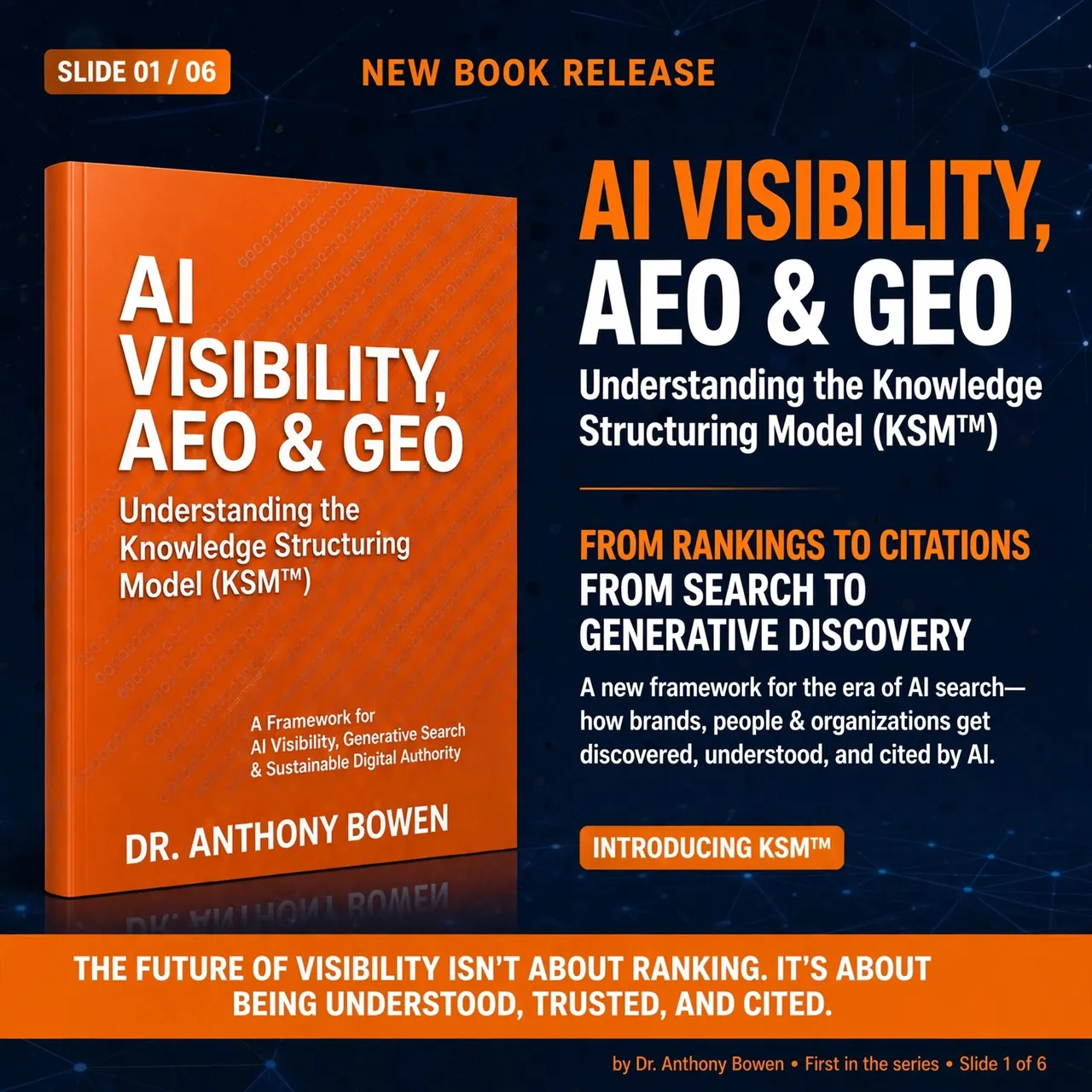
AEO & GEO
Understanding the Knowledge Structuring Model (KSM™)
A framework for AI visibility, generative search & sustainable digital authority — for the era when AI answers, not links, decide who gets found.
by Dr. Anthony Q. Bowen, DBA — creator of KSM™
Cited across 12+ SSRN eJournal networks
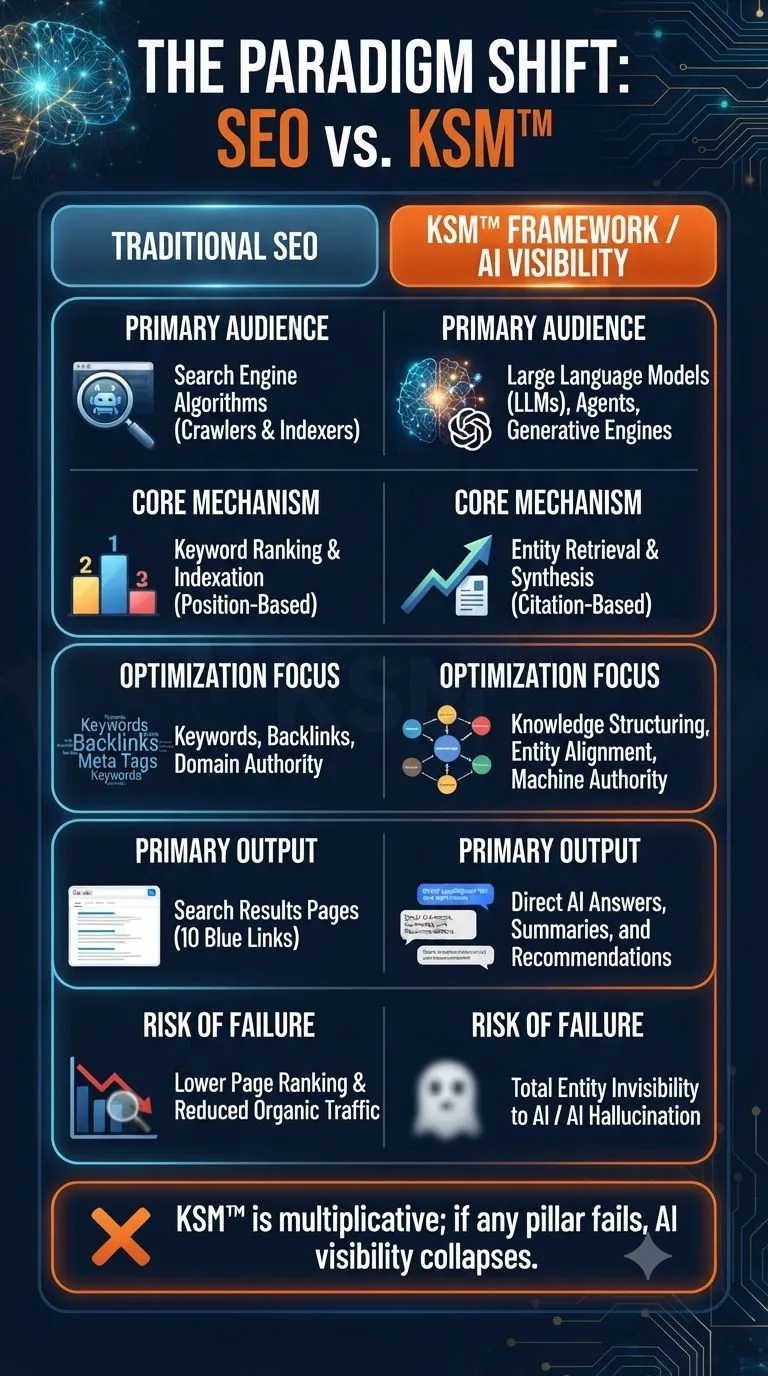
SEO earns the click. KSM™ earns the citation.
| Traditional SEO | KSM™ | |
|---|---|---|
| Optimizes for | Rankings | Citations |
| Signal | Keywords | Entities |
| Currency | Backlinks | Authority Signals |
| Goal | Traffic | Inclusion in AI Answers |
Is KSM™ a replacement for SEO? No. KSM™ builds upon SEO. Crawlability, performance, and link equity remain the substrate that extractability, entity salience, and citation authority are built on.
Three pillars. One equation.
Structured Extractability
Can AI understand your knowledge?
Content organized into clear, self-contained, semantically explicit units that a model can lift without distortion — headings, definitions, schema, and unambiguous claims.
- Machine-readable content supported by Schema.org vocabulary
- JSON-LD markup on every substantive page
- Self-contained answer units that survive summarization
Entity Salience
Can AI recognize who and what you are?
A consistent, well-linked entity identity across the knowledge graph, so systems resolve you to the correct person, organization, and body of work rather than a near-match.
- Entity clarity through knowledge graphs
- Wikidata presence where appropriate
- Consistent identity and deliberate entity linking
Citation Authority
Can AI trust and cite you?
Whether AI systems repeatedly select the organization as a trusted source — earned through durable identifiers, scholarly and third-party references, and stable provenance.
- Repeated selection as a source in AI answers
- Persistent identifiers (DOI, ORCID) behind claims
- Independent third-party corroboration
Assessment weights shown are from KSM™ Methodology v1.0. The original KSM™ paper defines the three constructs but does not assign assessment weights.
AI Visibility = Structured Extractability × Entity Salience × Citation Authority
The terms multiply rather than add, so a weakness in any one pillar suppresses the total — strong content with an unresolved entity, or a well-known entity with unstructured content, both collapse toward zero.
The KSM™ trail in 90 days.
- Paper 1SSRN 6721140 · May 2026
The Knowledge Structuring Model (KSM™)
Establishes the foundational framework for AI-mediated visibility: AI Visibility = f(Structured Extractability × Entity Salience × Citation Authority).
Read on SSRNeJournal distributions
- Generative AI Journal — Vol. 4, Issue 111
- Behavioral Marketing — Vol. 18, Issue 91
- Managerial Marketing — Vol. 18, Issue 88
- WUST Review — Vol. 1, Issue 1
- Paper 2SSRN 6899418 · June 2026
Warrant Clearing for Artificial Intelligence Agents
Co-authored with Jabran I. Chaudry
Extends the framework to preserving justified claims as they pass through recursive agentic reasoning.
Read on SSRNeJournal distributions
- CompSciRN: Computer Science Education — 125
- Software Engineering — 151
- CompSciRN Information Systems (Vol. 9, Issue 191 · September 30, 2026)
- Generative AI — 125
- Paper 3SSRN 7113181 · July 2026
Beyond AI Visibility: Extending KSM™ to Enterprise Knowledge Readiness (EKR)
Turns the framework inward, applying it to enterprise-internal knowledge readiness for agentic AI.
Read on SSRNeJournal distributions
- Entrepreneurship & Management — 143
- Management of Innovation — 137
- Organizations & Markets — 136
Three papers, one framework — from visibility, to justified claims, to enterprise readiness.
Author-reported research footprint: distributed across 12+ SSRN eJournal networks. SSRN working papers are author-submitted preprints and are not described here as peer reviewed.
The book is the manual. Here’s the next step.
Book
$29 (Kindle)
“AI Visibility, AEO & GEO: Understanding KSM™” — ASIN B0H4WXRLJB. The complete framework in one volume.
- Full KSM™ framework and pillar guidance
- AEO and GEO in one strategy
- Practical implementation sequencing
Book + Score
Book + free baseline
Pair the book with a free KSM™ AI Visibility Baseline Score so you know which pillar is limiting you before you start.
- Everything in the Book
- Free KSM™ AI Visibility Baseline Score
- Pillar-level starting diagnosis
Book + 90-Day Roadmap
Structured execution
A sequenced program that turns the framework into ninety days of prioritized work.
- Days 1–30 — Foundation: entity identity, schema baseline, and knowledge inventory
- Days 31–60 — Content, Entity & Authority: extractable content, entity linking, citation building
- Days 61–90 — Validation: re-scoring, AI answer checks, and measurement of inclusion
For Universities
Textbook + Audit Lab
An education pathway in which learners apply the book and the KSM™ Audit to a real organization, producing a defensible visibility assessment.
- Suitable for graduate business, marketing, digital strategy, and AI programs
- Learners run a real-organization KSM™ Audit
- Framework, rubric, and roadmap deliverables
Kindle price shown as author-provided ($29); see Amazon for current price and availability. Dr. Bowen has taught graduate business and marketing learners associated with GCU, SNHU, and JWMI; no institution has adopted or endorsed the Textbook + Audit Lab pathway.
From SEO rankings to AI-generated answers
AI Visibility
Whether AI systems can find, interpret, and reuse your knowledge when they compose an answer.
AEO
Answer Engine Optimization: structuring content so answer engines can extract precise, self-contained responses.
GEO
Generative Engine Optimization: shaping how generative systems represent, synthesize, and attribute your work.
Search still matters. It is no longer sufficient.
For two decades, discovery meant ranking. A query returned a list of links, and the work was to occupy a higher position on that list. That work still matters: crawlable, fast, well-linked content remains the substrate everything else depends on.
What changed is the destination. Increasingly, the query returns a synthesized answer. The system reads across sources, resolves what it believes to be true, and selects a small number of references to stand behind that answer.
In that environment, a page can rank well and still be invisible — never extracted, never attributed, never named. Visibility becomes a question of whether your knowledge is machine-interpretable and whether your entity is unambiguous enough to be trusted.
The competitive question shifts from “where do we rank?” to “are we the source the model chooses to cite?”
From a baseline score to shipped engineering.
- 01
KSM™ AI Visibility Baseline Score
- 02
Audit Report
- 03
Gap Analysis
- 04
Entity and Citation Review
- 05
Schema Recommendations
- 06
90-Day Roadmap
- 07
Implementation Guidance
- 08
Engineering Delivery
Six outcomes, written for people who have to act on them.
Why AI systems include some sources and omit others
How retrieval and synthesis decide which knowledge makes it into a generated answer.
How to make your entity unambiguous
Establishing consistent identity signals so systems resolve you to the right person, brand, and body of work.
How to structure content for machine extraction
Writing and marking up knowledge in self-contained units that survive summarization intact.
How citation authority is actually built
The provenance, identifiers, and corroboration that make attribution defensible for a model.
How AEO and GEO fit one strategy
Treating answer-engine and generative-engine work as complementary practices inside a single framework.
A practical implementation roadmap
Sequencing diagnosis, remediation, and measurement so teams know what to fix first and why.
Written for the people who own the outcome.
Executives & Boards
Leaders who need a defensible view of how AI-mediated discovery affects reputation, demand, and risk.
CMOs & Marketing Teams
Teams accountable for brand presence as the surface of discovery moves from pages to answers.
SEO & Content Leaders
Practitioners extending proven search discipline into extraction, entity, and citation work.
AI & Data Leaders
Owners of knowledge infrastructure, taxonomies, and the systems that make content machine-readable.
Consultants & Agencies
Advisors who need a structured, explainable model to diagnose and prioritize client work.
Academics & Researchers
Scholars studying information behavior, knowledge organization, and AI-mediated retrieval.

Dr. Anthony Q. Bowen, DBA
Dr. Anthony Q. Bowen is an executive AI strategist, digital transformation leader, researcher, and MBA marketing faculty member. He is the creator of the Knowledge Structuring Model (KSM™).
His work spans 25+ years across enterprise transformation, marketing technology, customer experience, and AI strategy, advising organizations on how knowledge is organized, governed, and represented inside AI systems.
The framework has a working paper behind it.
KSM™ was developed and documented in a working paper available on SSRN: The Knowledge Structuring Model: A Socio-Technical Framework for AI-Mediated Visibility and Citation Authority.
The model is socio-technical rather than purely tactical: it treats visibility as the outcome of how people, content practices, and machine systems interact.
Theoretical grounding
- Socio-Technical Systems theory
- Semantic Web and knowledge graphs
- Information behavior research
- Design science research methodology
The next era of visibility will not be won by publishing more. It will be won by structuring knowledge better.